Showing posts with label My favourite. Show all posts

Monday, February 18, 2008

The (maroon) ties that bind

from:http://thestar.com.my/lifestyle/story.asp?file=/2008/2/17/lifefocus/20318657&sec=lifefocus

From social science classes to social soirees, MCKK and TKC alumni flirt and flit about the society scene.

AT the launch of Tun Mahathir’s book in Putrajaya recently, Datuk Seri Megat Najmuddin Khas – respected corporate figure, stalwart of the Malaysian Institute of Corporate Governance and in this instance, a humble guest at the breakfast event – had a good laugh when a reporter asked about the ubiquitous maroon necktie sported by him and several other guests, including Tan Sri Abdullah Ahmad, the co-author of the aforementioned book.

At another event across the globe, I was approached by a Hermes-clad accountant in a quiet tea room in London, inquiring if I had once studied at the Malay College Kuala Kangsar (MCKK).

Boys (from left) Scomi CEO Shahzanim Zain, Sapura Oil & Gas director Rohaizad Darus and the writer at a recent reunion and, inset, as they were in 1978.
“You were my junior,” he said, “and we used to fight over the piano behind Hargreaves Hall, remember?”

Ironically, I was not even wearing anything maroon at that point in time.

MCKK alumni – whether they are reminiscing over a hole-in-one at KLGCC or hopelessly lost in Outer Mongolia – just seem to have that je ne sais quoi that makes them stand out from the rest.

“I think it is that maturity which we picked up during our formative years,” said top MAA executive Helmy Had Sabtu over cigars one afternoon.

“Residential schools, elite or otherwise, seem to accelerate mental development as we are surrounded by our peers, 24/7,” the 43-year-old reasoned.

“The need to conform, contradict and co-exist is constantly there while the bonds developed between us remain intact for a lifetime,” added lawyer Harmy Yusof, Helmy’s batch mate and tennis partner at the Royal Lake Club in Kuala Lumpur.

I wish I could agree with him as it took me a good 25 years to finally get round to attending my batch’s reunion.

From the business world to society circles, the alums have excelled in their chosen fields.

Historically, a slew of royals and leaders in the Malaysian Government service have headed the glittering list of MCKK’s successes.

Closer to home, my uncles, Raja Azam, Raja Kassim and Raja Biazid Raja Kamaralzaman, represented a league of gentlemen who made their marks during the Colonial years and beyond. My grandfather – the once Raja DiHilir Perak, Raja Kamaralzaman Raja Ngah Mansor – was the first head boy of MCKK, making yours truly the third generation of Perak royals to have graduated from the bastion of the Malay elite.

These days, Petronas boss Tan Sri Datuk Hassan Merican, businessman-philanthropist Tan Sri Mohd Saleh Sulong and Tun Mohammed Hanif Omar are among many prominent alumni, along with CIMB’s Tunku Ahmad Burhanuddin, Scomi CEO Shahzanim Haji Zain, society bon vivant Johari Abas and the late actor Hani Mohsein Hanafi.

Even as I speak, a few fledgling luminaries are honing their ambitious society chops, probably inspired by PR-savvy property developer Datuk F.D. Iskandar and the perpetually smiling Datuk Latt Shariman.

Come every Wednesday, they magically pop out from the woodwork with their maroon-and-gold badges of honour.

“There’s a beaming sense of silent camaraderie if we chance upon other ‘Old Boys’ at lunch time,” said Maybank’s Rudy Rodzila.

Undoubtedly, the networking among MCKK Old Boys remains unsurpassed. God bless the parents who gritted their teeth to send their teary first-borns to the alma mater. The investment and sacrifices have definitely paid off in these days when one needs to know who’s who to excel in life.

Rumour has it that Renong Group, under the helm of business titan (and respected alum) Tan Sri Halim Saad, was a veritable collection of Old Boys, one of whom was this writer.

Once dubbed the “Eton of Asia”, MCKK’s appeal seems to have survived the test of time since its royal inception back in 1905.

Snob appeal? Not necessarily – I think it’s a proud tradition of well-placed humility and self-esteem generated through good family values sprinkled with a healthy lashing of MCKK’s sterling student culture.

Harga diri! Self-respect! We were taught to have confidence in ourselves,” Megat Najmuddin recalled over breakfast at his house last week.

“That is why we Collegians can stand tall and look eye to eye with anyone in the world.”

But it’s not all a bed of roses being a Budak Kolek. Of late, snide remarks about the school churning out closet ? erm, cases ? seem everywhere, accompanied by sneering sniggers and sideway glances.

“We don’t see it as a problem and we are simply too secure to even acknowledge it,” said Megat Najmuddin, who is also the President of MCKK Old Boys Association.

“Besides, we would rather direct our valuable energy towards more productive challenges, like reducing our golf handicaps,” he laughed.

But one challenge no red-blooded alum can resist is the come-hither allure of MCKK’s feminine counterpart, Tunku Kurshiah College (TKC).

“We used to envy our mates who participated in the Piala Perdana Menteri because they had access to the brainiest beauties during the debate preliminaries,” recalled Nik Ahmad Farid. “Those who had sisters studying there got our vote as well.”

The Piala Perdana Menteri – probably the only national debate in Malaysia that gets televised other than heated Parliament proceedings – was an inter-residential school competition held annually to hone the best speakers among the junior set.

“My first visit to RTM’s Auditorium Angkasapuri for the finals way back in the 1970s was to cheer on our debaters while the TKC team sat adjacent to us,” recalled Helmy Had.

Did our sorority sisters have similar life-defining values? Do they wear secret identity tags – a day-glo scrunchie, perhaps – on stipulated days every week?

I approached respected author and TKC and Convent Bukit Nanas alumnus Dina Zaman for her side of the story.

“After a succession of several schools – my family moved around a lot – I found TKC very disciplined and regimented! There was strict scheduling but I learnt to adapt well by being a keen observer, and kept a detailed journal,” she said.

“My batch was quite bookish, unlike the fun-loving juniors.”

By “bookish”, Dina also meant romance novels craftily sandwiched between trigonometry textbooks: “In TKC, dog-eared issues of Harlequin romances and Barbara Cartland novels were traded like contraband,” she laughed.

“And to set the record straight, we do not have any iconic apparel that we have to wear on specific days of the week.”

Though not as old as MCKK (the ladies would not admit to their ages, anyway), TKC has churned out an impressive list of national heroines such as Datuk Rafiah Salim, the current Vice Chancellor of Universiti Malaya; Tunku Dara Naquiah; respected banker Raja Teh Maimunah (Kak Onn to the Old Girls); and socialite Datin Tengku Halimah, who is Dina’s aunt.

“We celebrated our 60th anniversary last year with the royal presence of three state rulers – of Perak, Selangor and Negri Sembilan – and what a bash it was,” said serial blogger Ruby Ahmad.

“My compatriot in TKC then was Datin Paduka Marina Mahathir but the one endearing personality even way back when was our current Women, Family and Community Development Minister, Datuk Seri Shahrizat Abdul Jalil.

“Sherry (as the teachers called her) excelled in elocution classes. Plus, she was a stunning beauty and the headmistress remembered her as the ‘one with the mesmerising eyes’.

“We had American Peace Corps and British volunteer service teachers as our staff.

“Things were different back then – the teachers were worldly-wise and committed beyond the classroom to motivate us to excel educationally and become exemplary individuals in our own right without losing sight of our Asian values and morals.

“This came in useful when we studied abroad later. Things have become quite sanitised these days,” she reminisced.

While my MCKK mates would have their locker doors plastered with posters of Brooke Shields, Suzanne Sommers and Farrah Fawcett Majors (my teenage crush was Malaysian model Maria Kamaruddin, now a still-stunning Datin as well), one TKC girl that had major impact on our spotty hormonal existence then was former beauty queen Yasmin Yusoff, an elegant presence in the current social scene.

Looking back, though the MCKK and TKC did not enjoy the summer-camp sensibilities of the current National Service, the alma maters’ vision and values have definitely stamped an indelible impression on many of its graduates.

Undoubtedly, there are and will be other proud institutions churning out notable personalities that grace the Malaysian annals of societal fame but, somehow, it is hard to ignore that particular maroon tie worn proudly every Wednesday, year in, year out.

  • Social observer Mansor Tun Abdul Aziz revels in the beauty and irony of KL society in his fortnightly column.
  • Wednesday, November 28, 2007

    The Day Hang Tuah Walked Through My Door - by Adlan Benan Omar

    Everyone knows who Hang Tuah is. Everyone knows that he was a great warrior, that he was loyal to his king, that he fought and defeated Hang Jebat in a gruelling duel. But I knew more about Hang Tuah than anyone else. No... I didn't read more than anyone else (how much more could a twelve-year-old have read anyway?). I knew more about Hang Tuah because he came to live with us a few months ago.

    Yes, you heard me right. Hang Tuah did come to live with me and my family. Abah took him home one day. He had found the old man walking around the local playground one evening, while he was out jogging. It was getting dark and the old man had no place to go, so we took him in. Mak was not too happy about that, she thought the old man looked crooked. He was dirty and he didn't wear shoes. Mak said that people might think our family has gone weird. Abah just laughed. "Kasihan ...dia orang tua," he said.

    My friends didn't believe me at first. They thought I was dreaming, or making things up, or just plain lying. Azraai said that the old man was an alien from Mars and not Hang Tuah. Eqhwan laughed at me and said that either I or the old man must be mad. Anuar said that if Hang Tuah was still alive I wouldn't be able to understand what he said because he spoke classic Malay like in the hikayats. Hilmi (our local school's smart alec) tried to explain to me that the Melaka Empire was no more and that Hang Tuah was just a legend. He said that if Hang Tuah was still alive he would be at least five and a half centuries old and the latest edition of the Guinness Book of World Records stated that the oldest man in the world lived only to 120 years. Only Farid sympathised with me... and that was because he had an imaginary friend whom he always took along to play marbles with us.

    I really didn't care what they said. I knew that old man was Hang Tuah. I know because I asked him myself. The morning after we took the old man in, Mak asked me to wake him up for breakfast. I went to the spare room and found that he was already awake. He was sitting on the edge of the bed with a blue batik bundle on his lap.
    "Jemput makan, Tok," I said, politely.
    "Terima kasih," he said.
    I was curious, so I asked, "Apa dalam buntil tu Tok?"
    "Barang Tok... barang orang miskin," he replied.
    Then he opened it up slowly. I saw him fiddle for something, then he took out a long keris with an ivory sheath. It was at least a foot long and studded with jewels.
    "Ini keris Taming Sari," said the old man.
    I snickered, "He! He! He!". I thought the old man was joking. Everyone knew that Taming Sari belonged to Hang Tuah and that it must have disappeared with its master.
    The old man looked up at me. His eyes stared into mine. I felt a little queasy at that. His expression changed, he began to look angry. Suddenly his eyes drooped and he looked more hurt than angry.
    "Kenapa cucu gelak?" he asked.
    "Tak ada kenapa," I answered, a little frightened.
    "Tok tahu, cucu ingat Tok bergurau." I kept quiet.
    He began again, "Inilah keris Taming Sari yang sebenar. Ini keris Tok sendiri."
    "Kalau begitu Tok ni tentulah..."
    "Hang Tuah," he interjected, "nama Tok ialah Hang Tuah."
    "Tapi Hang Tuah sudah mati."
    He laughed, "Tidak, Tok belum mati. Tapi Tok sudah tua..."
    "Berapa umur Tok?" I questioned.
    "540 tabun."

    Mak didn't really like Tok Tuah. But she didn't say anything when he just stayed on and on in the house. She didn't say a word when Abah and I took him to Hankyu Jaya to get some new clothes. She just kept quiet when Tok Tuah joined us to watch TV in the living room after dinner. I told her (and Abah) that the old man said that his name was Hang Tuah. She wrinkled her face (and Abah just laughed).

    It was a Wednesday night and RTM had a slot then called "Teater P. Ramlee". It so happened that they were showing Phani Majumdar's "Hang Tuah". P. Ramlee, so young and thin, acted as the hero and the late Haji Mahadi was Sultan Mansor Shah.
    When Jebat got killed, Tok Tuah pipped in, "Tidak langsung macam tu..."
    Abah stared at Tok Tuah. Mak stared at Tok Tuah. I too, stared at Tok Tuah.
    "Aku sudah tua masa tu, Jebat muda lagi. Jebat kuat. Dia sepak aku hingga aku tertiarap, kemudian aku berguling. Aku himpit dia. Aku kata sama dia 'baik sajalah kau mengalah'. Apa gunanya kita dua bersaudara bergaduh?"
    Mak started to look worried again.
    "Jebat tak mati."
    Abah looked surprised. He said, "Habis tu, apa jadi pada dia?"
    Tok Tuah said, "Aku tak mahu Sultan bunuh dia. Aku tahu Sultan zalim. Jadi, aku sorokkan dia di Ulu Melaka. Macam Tun Perak sorokkan aku masa aku difitnahkan. Lepas Melaka kalah dengan Portugis, Jebat ikut aku merantau."
    I said, "Bila Jebat mati?"
    Tok Tuah laughed, "Jebat belum mati. Baru tahun lepas aku jumpa dia. Dia meniaga di Kedah."
    "Meniaga?" I said.
    "Ya, Jebat duduk di Kulim. Dia meniaga kereta. Apa tu? Kereta 'second-hand' kata orang. Proton, Honda dan Nissan. Laku jualannya. Banyak orang beli."

    One day, I took Tok Tuah on a walk around KL. He got bored just sitting in our small bungalow in Bukit Bandar Raya. So after school, we took the mini-bus to Central Market. Tok Tuah really enjoyed the walk. "Banyaknya orang..." he wondered. We ate at McDonald's. He didn't like the cheeseburger (well, he didn't like the cheese, though he loved the burger itself). After lunch, we went to Muzium Negara.

    I showed him the frieze of a young Hang Tuah which was sculpted by an Englishwoman in the 1950s. It showed a handsome Hang Tuah in 'Baju Melayu' and 'samping'. He was holding Taming Sari in his hand.
    "Siapa tu," Tok Tuah asked.
    "Itu Tok-lah. ltulah orang putih gambarkan sebagai Hang Tuah. Hensem, kan?"
    Tok Tuah chuckled, "Apa tulisan atas tu?"
    "Ta' Melayu Hilang di-Dunia. Eh, takkan Tok tak ingat? Itu kan Tok yang cakap dulu?"
    He kept quiet. Slowly he mumbled, "Ta' Melayu Hilang di-Dunia? Tak ingat pun."
    Suddenly, he started, "Oh! Bukannya Ta' Melayu Hilang di-Dunia. Silap tu. Tok tak pernah cakap macam tu..."
    "Habis tu?" I asked.
    "Masa tu Tok tengah pergi masjid untuk sembahyang Maghrib. Isteri Tok ikut sekali. Dia tengah ambil air sembahyang di tepi perigi, kemudian kakinya tergelincir. Dia terjatuh masuk. Orang ramal pun menjerit-jerit sebab perigi itu dalam. Apa lagi, Tok pun terjunlah untuk selamatkan dia. Isteri Tok bukan sebarang orang, namanya Tun Sa'odah, anak Bendahara Tun Perak."
    "Kemudian?" I urged.
    "Bila Tok bawak dia naik, Temenggung Tun Mutahir ketawa. Katanya, Tok sayang betul pada isteri Tok. Tok pun jawab, "Mestilah... Ta' Isteriku Hilang di-Telaga. Jadi, mungkin orang silap dengar...!"

    Tok Tuah stayed with our family for more than six months. He stayed at home in the first few weeks but he felt guilty not doing anything to contribute. So, one morning, he followed Abah to work. Abah was manager of a factory in Sungai Buluh which made video tapes and CDs. They needed a new 'jaga' or watchman. Tok Tuah got the job. Abah said, "Who better to guard us than the great Malay admiral Hang Tuah?"
    The workers got along well with him. Amin, Abah's driver, said that Tok Tuah told them lots of funny jokes about Sultan Mansor of Melaka and his fifteen wives. Tok Tuah also got to know Rajalinggam, the sweeper, who he said reminded him of Mani Purindan, the father of Bendahara Tun Ali. Like Rajalinggam, Mani Purindan too came from Tamil Nadu and cooked delicious dhal curry.

    One morning, my teacher at school said, "Tomorrow I want you all to bring a model of an old artefact. Then I want you all to explain its importance in front of the whole history class."
    Hilmi (always the teacher's pet) spent days working on a matchstick model of the Kuala Lumpur Railway Station. Azraai decided to build a spaceship instead. Eqhwan bought Anuar's origami keris for fifteen dollars and brought that to school. Farid asked his imaginary friend to draw a picture of Mel Gibson as Sir William Wallace. I? Well, I just brought Tok Tuah along.
    My teacher was flabbergasted. She said, "Why have you brought this 'jaga' along?"
    I smiled, "He's not just a 'jaga'. He's the great warrior Hang Tuah!"
    My teacher said, "I'll call your father and tell him you're playing jokes in class."
    "Please, Cikgu. Just listen to what he has to say," I insisted.

    Tok Tuah stood in front of the class. He coughed. My teacher sighed. I smiled. My friends sneered. "Assalamualaikum," he said. "Wa'alaikum Salam," we answered.
    Tok Tuah began his speech. He started out by saying that the Melaka we read about in the history books was very different from the real Melaka. He explained how the Sultan used to let anyone come to the palace with any complaints at all, and he would settle it there and then. He told us that he and his four friends used to go on tours to Pahang and Terengganu and Ujung Tanah, even to Siam, on great galliards with five big sails. He described to us that Melaka had 120,000 citizens, each of whom had land and houses of their own and that no beggars were allowed to go even a day without food and shelter. He mimicked Sultan Mansor's snarl, and Tun Perak's twitching handlebar moustaches and Jebat's swaggering walk. Finally, he told us how Melaka got corrupted by its wealth and warned us not to do the same now.
    That day, Tok Tuah got a standing ovation. Even Teacher clapped. I? I got an 'A' for History.
    Tok Tuah died seven weeks after that. He was 542 years old. It was during the Puasa month and he took the LRT from Sungai Buluh. He wanted to stop and buy some sweetmeats (he absolutely loved 'pau kaya'). When he arrived at Chow Kit station, he collapsed on the platform with a massive stroke.

    They rushed him in an ambulance to Kuala Lumpur General Hospital but he was already gone. He didn't feel a thing. We buried him at Ampang Cemetery, right across from the grave of Tan Sri P. Ramlee, who played him in that film. I visit the grave sometimes just to tell him that I'm now a lecturer in Malay History at Leyden University.

    I still remember the day he walked through my door. It's as if it was just yesterday. Ah, well...
    By the way, did I tell you I met King Henry VIII whilst I was studying in Cambridge? He worked as a night porter at my college. But that, as they say, is a different story.

    TAMAT
    from : http://www.cumas.org/cd/articles/memories/hangtuah/index.htm

    Sunday, March 11, 2007

    They don't sell BRA in Hollywood ya?


    I found another stupid excuse by Linda Onn today on one tabloid.. She cant wear RR's kebaya because she doesn't have matching bra... ha ha ha.. seems that she only has pink and black bra ONLY in her luggage.


    Must be an insult to America that she can't get other bra in the whole of US of A. Its either that or her tits are just too small to fit into American bra. Now I really believe she is damn bloody stupid offering stupid excuse like we Malaysians are really stupid to believe her.
    Wonderbra, Victoria Secret, Triumph all have no size for her?

    Monday, September 25, 2006

    Cobain's suicide letter


    I stumbled on this while trying to find more info on the death of Kurt Cobain, the frontman for Nirvana... the super grunge band that made grunge scene "fashionable" in the 90's....

    On April 8, 1994, Cobain was discovered in the spare room above the garage (referred to as "the greenhouse") at his Lake Washington home by Veca Electric employee Gary Smith. Smith arrived at the house that morning to install security lighting and saw him lying inside. Apart from a minor amount of blood coming out of Cobain's ear, Smith reported seeing no visible signs of trauma, and initially believed that Cobain was asleep. Smith found what he thought might be a suicide note with a pen stuck through it beneath an overturned flowerpot. A shotgun, purchased for Cobain by Dylan Carlson, was found at Cobain's side. An autopsy report later concluded Cobain's death was a result of a "self-inflicted shotgun wound to the head." The report estimates Cobain to have died on April 5, 1994.

    In the alleged suicide note, ostensibly written to Cobain's imaginary childhood friend "Boddah", Cobain quoted a lyric from Neil Young's song "My My, Hey Hey (Out of the Blue)": "It's better to burn out than to fade away." Cobain's use of the lyric had a profound impact on Young, who recorded portions of his 1994 album Sleeps with Angels in Cobain's memory. The note also invoked the name of Queen frontman Freddie Mercury, who Cobain felt could revel in the adoration of an audience in a way that Cobain himself could not.

    Cobain's body was cremated, with one third of his ashes scattered at the Namgyal tibetan buddhist monastery in Ithaca, New York, another third in the Wishkah River, and the rest left in Love's possession.

    http://en.wikipedia.org/wiki/Kurt_Cobain#Cobain.27s_final_weeks

    Thursday, August 17, 2006

    Di mana nak cari Melayu

    received this in the mailing list.... enjoy;

    Di mana boleh cari ramai Melayu?
    Pastinya di Kelantan dan Terengganu
    Dan juga di pasar malam dan pasar minggu
    Di Akademi Fantasia dan Pesta
    Di Jom Heboh orang Melayu berpusu-pusu
    Di Sungai Buloh, pusat pemuilihan, dulu di Pudu
    Dan di jalan, lumba haram, rempit tak berlampu
    Dan di selekoh duit rasuah depa pun sapu
    Di pusat serenti akibat ketagih dadah dan chandu
    Di malam kemerdekaan dan malam tahun baru
    Terkinja-kinja best giler menari macam hantu

    Apa hobi orang Melayu
    Terkenal dengan budaya malas dan lesu
    Berlepak buang masa tak jemu-jemu
    Atau baca majalah Mastika, Metro pasal cerita hantu
    Tengok telenovela dari Filipina dan Peru
    Berpusu-pusu pergi tengok pamiran hantu
    Sambil makan junk food, kuaci dan muruku
    Sibuk bercerita tentang Datuk K dapat bini baru
    Apa pakaian Siti nak pakai itu yang nak tahu
    Mana tak gendut berpenyakit selalu
    Kalau nak berlagak melayu masih nombor satu
    Asal bergaya sanggup makan nasi dan toyu


    Boleh tak jumpa mereka di kedai buku
    Atau di perpustakaan dan majlis ilmu
    Atau ambil kelas kemahiran di hujung minggu
    Ada tapi kurang sangat mereka di situ
    Kenapa melayu jadi begitu
    Nak salahkan siapa ibubapa atau guru
    Pemimpin negara atau raja dulu-dulu
    Ayat lazim di mulut ialah Melayu malas selalu
    Nak harap Kerajaan saja membantu
    Terutama sekali kontraktor kelas satu
    Tak habis-habis gaduh nak jatuh siapa dulu
    pasal jambatan senggek atau siapa dia penghulu
    Dan suka sanggat dengan budaya ampu mengampu

    Sampai bila kita nak tunggu
    Bangsa Melayu jadi bangsa yang maju
    BOleh! dengan beberapa syarat tertentu
    Pertama dengan banyak menguasai ilmu
    Kata nabi ikutlah Quran dan sunnah ku
    AlQuran yang diturunkan 1400 tahun dahulu
    tapi apa yang kita tahu, cuma baca bila nak halau hantu

    Sunday, August 06, 2006

    Lesson in Bahasa Melayu

    I am fascinated everytime I read the writing of a certainmember in my alma mater mailing list. The way ho wrote his posting make me compare him my my own dad who is a master of linguist. I produce some of his writings below.. I hope he wont mind;

    On the word 'sahaya'...

    Lazimnya 'sahaya' itu dipakai dalam rangkaikata 'hamba-sahaya' sbg alternatif kpd 'hamba-abdi'. Dlm tulisan/makalah/surat dulu-dulu, lazim ditulis sin-ha-alif-ya (sahaya) bg perkataan tsb dalam aksara jawi. Dlm Hikayat Hang Tuah, Hang Mahmud (ayah HTuah) menjawab "Baiklah tuanku, ke manatah sahaya bertaruhkan diri, jika tiada di bawah kadam?" [Yes milord, where would I place myself, if it wasn't under the soles of yr feet?] bila disuruh oleh Bendahara untuk membawa masuk menghadap anaknya HTuah.
    Kadam = tapak kaki Kaus = kasut Duli = habuk di bawah tapak kaki Raja.

    Oh my goodness... now I know how feudal we are.. I mean the Malays. Us normal people is lower than the dust on the feet of the King hence Ke Bawah Duli YMM etc.

    On the word 'pacal'..
    'Pacal' bukan bermaksud anjing betina. Ia bererti pecacai dlm bhs Kedah/Perlis/PPinang yakni hamba baik kepada raja khasnya. Memang ungkapan begini adalah bersifat kefeudalan sebab asal-usulnya dari kepercayaan Hindu, yakni seseorg bila dipertingkatkan martabatnya melalui proses tertentu termasuklah bersiram-tabal, bertabal-pusaka, dipernobatkan dsb bertukar menjadi kudus/suci/sacred, seterusnya memiliki 'mana' atawa Melayunya 'daulat' yakni satu kuasa ghaib dlm tubuh tuannya yg boleh menyebabkan pengaruh/ akibat baik maupun buruk kpd org lain.Dlm ungkapan Melayu 'timpa-daulat' mithalannya atawa 'tak-tahan daulat' atawa 'kena-tulah' dsb.adalah akibat tersalah perilaku atawa niat terhadap org yang mempunyai 'mana'(dlm bhs Polinesia) atawa 'daulat' dlm bhs Melayu.Faktor kekudusan adalah untuk menegakkan legitimacy seseorg Raja
    Olamak... hina betul orang biasa ni, dah la hamba sahaya, pacal yang hina pulak tu
    On Bahasa Indonesia;
    Kalu kat Jakarta, KP Kastam tu akan disebut DirjenDepartemen Cukai dan Bea (Bea tu excise which has nothing to do with biawak!). Kat sini banyak kita guna bahasa Belanda yang dicuriguna via bhs Indonesia i.e. all words ending with '-si' (for words ending with -tie in Duth) like delegasi / lokasi /prestasi. Some are of course directly from Dutch like duit (from Dutch doit which refers to the old Dutch coin) Dan kita juga ambil balik ungkapan bhs Melayu dengan sebutan salah dari sana e.g. keraton (dr keratuan), prihaten (dr peri-hatian), calon (dr calu-caluan), lakon (dr laku-lakuan), pesantren (dr persanterian), kabupaten (dr kebupatian) dll.

    Others;
    I use 'tunanetra' instead of 'buta'.When I was young 'buta' was not a polite or refined word.The word 'kelam' was more acceptable. Likewise in Javaland, they use more Sanskrit to circumvent impolite local words. Hence tunasusila for prostitutes and tunanetra for the visually impaired! You of course know tuna is not an ikan tongkoi/kayu/aya!

    Thursday, August 03, 2006

    It is glorious to be rich

    I received this article written by Raja Petra Kamarudin from another friend. Sorry I can't point you to the original website, its out there some where but, excerpts are posted here;

    I was the first in Terengganu to order a locally-assembled Mercedes Benz 380SE (hey, allow me to brag once in awhile). Actually, I preferred my BMW728i. But I was then the Mercedes franchise holder for Terengganu and one day I fetched the German engineer from the airport in my BMW and he refused to step into my car and asked me to get him a taxi instead. He was joking of course, but Germans are not known for their jokes so it was very hard to tell if he really meant it or not.

    But on 28 July 2006, I was reminded what it is like to be a rich Malay businessman in the East Coast. I had arrived in Kota Bharu a day earlier to look into the preparations for streaming live Tun Dr Mahathir Mohamad's address at Hotel Perdana. On the 28th, my wife and I drove to the Pengkalan Chepa airport to await Mahathir's arrival. I thought I would check out the crowd and take some action shots as well.

    Around an hour before Mahathir was due to touch down, a string of mafia-looking black limousines zoomed into the airport and parked right in front of the exit, blocking the entire airport. One guy who gave an appearance of being in-charge jumped out of the lead car with about half a dozen or so tough-looking chaps, who I thought at first were members of the SWAT team, trailing behind him. They were dressed in boots and jackets and seemed to be sort of in uniform. Not only their appearance but the manner in which they conducted themselves gave this impression. The chap did not agree with me. "These are not from the SWAT team," he corrected me. "These are kaki gedebeh (gangsters)." They marched right up to Tan Sri Abdullah Ahmad and the leader of the very menacing-looking bunch demanded that Mahathir be allowed into his car. Abdullah would not engage him and advised him to phone Mahathir himself to discuss the matter. Anyhow, said Abdullah, Mahathir's representative is around so why not discuss it with him.

    There was a moment of chaos and even the local police chief who was present could not contain the situation. I asked Abdullah who this chap who seemed to have so much power that he can even ignore the police is. He is a rich man replied Abdullah in utter disgust. Yes, being rich is glorious as the Chinese Premier once said. Being rich means you can get away with much in the Malay heartland. And that is why this rich Kelantanese wanted Mahathir in his car. He is rich, richer than Ibrahim Ali and Abdullah Ahmad combined, so only he is entitled to ferry Mahathir to the hotel. And when Mahathir chose to enter Ibrahim Ali's car instead, he went into a rage and sprayed the inside of the car with mace, hitting Ibrahim, Mahathir and scores of other people who were standing nearby.

    I am glad that the New Economic Policy is a failure. I am glad that these types of rich Malays are a rarity. Imagine what Malaysia would be like if we had thousands of such people roaming the streets. No one would be safe. What they want they get. And if they don't get their way they would spray mace into your face in front of the local police chief or take out their gun and shoot into the air like what happened twice before during Umno Division meetings in Tumpat and Klang.

    Oh, by the way, both these people who took their guns out and shot them during the Umno division meetings were never charged. This is of course not only because they are Umno chiefs, but because they are rich.

    I couldn't agree more. Money maketh a man I guess. To some who is used to going through life with a little bit of money in the pocket is good enough. To them life is bliss, he is happy, being the guy next door who will help other if it needs be or join in the kenduri in the neighbourhood even if not invited personally by the houseowner. BUT give this people tonnes of money an Mat Melayu will change. Money is power and power in the wrong hands just spell trouble to others.

    Personally I met RPK around 1997 when he actively visited our office in Wisma Denmark, him being a business man , me being a junior who respect him as a senior :). Fun guy.. serious when he wanted to be and what a sight with his chopper.. is it Virago 535? Maybe.

    Friday, July 14, 2006

    Melayu masih "berjiwa hamba"

    Interesting article by Anuar Mohd Nor from http://www.umno-reform.com/URnews/jiwa_hamba.htm which I (partly) re-publish here;

    Dr Siddiq Fadil dalam bukunya Melayu Baru menulis - selagi Melayu berjiwa hamba selagi itu kita akan terbenam dalam kancah ketinggalan. Ulasan Dr Siddiq mengatakan bahawa salah satu kreteria yang perlu untuk memajukan Melayu ialah dengan pengikisan perasaan jiwa hamba dan memerdekakan diri. Kita dengar- kata - kata Dr Burhanuddin Helmy - " di atas robohan kota Melaka , kita dirikan jiwa merdeka" masih susut dari segi percapaiannya. Jiwa kita tidak merdeka - terkongkong dengan perhambaan tidak menggalakkan perubahan - dari kongkongan feudalism " ke 'raja' an, "kesultanan" kepada kongkongan feudalisma "politik" dan penjajahan dalaman. Perjuangan menuntut jiwa merdeka tidak akan berjaya selagi kita masih kaku dibelenggu aspek - aspek ketakutan. Kita dari satu sudut menuntut perubahan Melayu - menuntut perubahan minda - menuntut sikap Melayu Baru tetapi semua - belenggu halangan di ketatkan dan dalam masa yang sama Melayu terus terkongkong untuk tidak menggeleng tetapi mengangguk. Kesedaran harus dibentuk dengan mengakui betapa tercicirnya kita dalam semua bidang - ketinggalan dan kini bangsa kita Melayu terus diperhambat ketepi untuk menjadi penonton kepada pembangunan negara.

    Jiwa hamba akan hanya dapat dikikiskan selagi kita sedar bahawa bangsa kita akan pupus dan tanda - tanda awal kepupusan kita sudah terhidang tanpa kita sedari. Kita perlu meningkatkan perekonomian bangsa, kita perlu memperkasakan bangsa tetapi hanya segelintir Bangsa Melayu Perdana yang berjaya dengan segala ketamakan haloba. Kita harus bebas berfikir - terbuka "option" untuk memilih. Adakah bangsa Melayu perlu hadir untuk menyokong apa yang ada tanpa banyak mempersoalkan tindakan, harus mengangguk sementara Melayu Perdana wujud untuk terus memanipulasi keadaan untuk kepentingan segelintir yang akan meningkatkan statistik palsu kejayaan negara.

    Melayu Perdana - budaya feudalistik Dr Siddiq Fadil menyimpulkan " Unsur - unsur yang bersifat budaya feudalistik harus ditinggalkan". Ini termasuklah unsur - unsur pendewaan terhadap seseorang tokoh dan penghambaan diri kepada mereka. Segelintir Melayu Perdana inilah yang nampak masih mempertahankan budaya feudalistik - mahu terus Melayu berjiwa hamba. Inilah senario yang wujud dan ialah sebenarnya yang membataskan Melayu itu - bukan mudah lupa - bukan malas tetapi terus di tipu oleh golongan Melayu Perdana - berkuasa dan terus berkuasa.

    "In short we should move out from our normal thinking process to gain 'Jiwa Merdeka'. Unfortunately there are this Melayu Perdana element who still try to keep us under our old thinking hats for them to be able to clean up the country out of its wealth".... my 2 cents worth

    Thursday, November 24, 2005

    Melayu oh melayu...

    We've seen some negative comments about the Malays mushrooming on the net. This racial slur only underline the fact that underneath the racial harmony our leaders projected to the the world at large, there is a huge wave of discontent among races. Yes I do read those comments, sometimes we need a big jolt to help us open our eyes wide to realise it. Some comments like the one below.....

    While the stupid malays scream and shout, the non-malays quietly dominate the economy of this country.

    Malay rights means:

    • if you are Umno malay, you get university seat even you are fool
    • you must be given 5% discount whenever you are buying a new house-No matter how rich you are
    • you must be given shares. Once you got, you can sell it to non-malay and asking for more shares
    • it's the duty and responsibility of government to keep feeding with sliver
      spoon
    • the malays will never learn anything other than blaming non-malays for their failure.

      And i always wonder y u guys build so many mosque for u guys dun even attend it
      ...

    I believe that in every race and culture there are always going to be good people and bad people. Most times we find more good than bad ones, unfortunately it is always because of the actions of the minority, the society as a whole is blamed for it. I would dismiss the notion that Malays are lazy. Malays are a hard working lot, just look at the paddy farmers, fishermen etc, the only snag is, low productivity and the idea of moderation, more like 'cukup makan sudahlah'.

    A truly bangsa Malaysia by 2020? I don't think so, not yet.

    Friday, November 04, 2005

    is the word KELING derogatory?


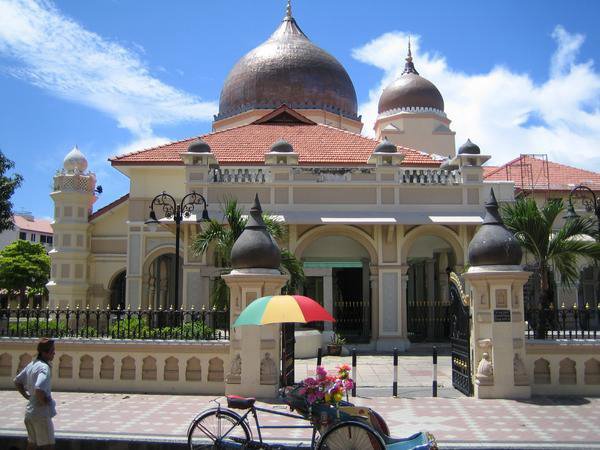
    The Kampung Keling Mosque, Melaka

    During the final day of Ramadhan, while waiting to break fast, I had a chat with my dad, just a simple chat trying to pass away time. Out of nowhere the word KELING came into the discussion. My Mom like to use that word and I keep on telling her that she should control the usage of that word as we have quite a few families of Indian origin in the neighbourhood.

    My dad feel strongly that the word is not derogatory, in fact he pointed out historical reasoning that that particular word has always been used even in the Malay Annals (Sejarah Melayu) for example, occurs in the second chapter dealing with the exploits of RajaChulan, whom the emperor of China is said to refer to as 'Raja Keling' or even such as Hang Nadim's visit to'Benua Keling' - which must refer to India generically. This reminds me of a debate not long ago that a group is planning to sue Dewan Bahasa & Pustaka over the usage of 'keling' in the dictionary even when the DBP dictionary has already designated the word as "kata kuranghalus" followed by the remark of Badruddin Amiruldin (BN-Jerai) in Parliament on Oct 25 (see also Bernama)

    Sabri Zain pointed that Nicholas Belfield Dennys' 'A Descriptive Dictionary of British Malaya' (1894) defined 'Kling' as "a general term for all the people of Hindustan, and for the country itself". Scareboeus is quoted in the 16th September 1887 issue of The Penang Gazette as stating that "the word Kling is a most interesting one and points to a connection between the Straits and India reaching nearly as far back as the time of Alexander the Great, the only trace of which remains in its continued application to the natives of Southern India."He adds that the word was not only used in the Straits but all over theDutch and Portuguese possessions in the East Indies.What is important to note, however, is that none of these examples ofthe use of the word or references to 'kelings' - from the Sejarah Melayu in the 16th century down to the British travelogues of the 19th century- were in any way used in any derogatory sense or intended as racial slurs. It was simply a word to describe the people of South India or their descendants in the Peninsula. We've heard of 'keling mabuk todi' or 'keling karam' - but I doubt if 'India mabuktodi' or 'India karam' would be deemed less of a racial slur.

    I guess those terms must be looked upon as one of our invaluable heritage to be preserved! in the days of yore,"kelings" travelled on ships from the indian ports and anyone who has been in their company must be accustomed to their love ofover-dramatizing situations and exaggeration. This is a historical perception of "kelings" and it is essential to keep such term intact so that future generations may not lose sight of their cultural roots. Our past colonial administrators have labelled the malays as variously as "indigent","indolent","lazy",etc etc but i do not recall that any malays ever clamouring forthese references to be removed.

    Maybe Norman Fernandez in the article in Malaysiakini ‘Keling’ remark: MIC impotent, without dignity and Premnath Badruddin belongs in circus should take a note here.

    Photo: Masjid Kapitan Keling, Penang

    Oh and some info out of the topic... if you are really a fan of Penang Nasi Kandaq, try the Nasi Kandar right next to Masjid Kapitan Keling in Penang. Its only available at night and even at 2a.m. you will find people queuing in front of the shop.

    Tuesday, September 13, 2005

    The Real Malay by Sir Frank Swettenham (1850-1946), Colonial administrator


    One of the architects of British Malaya, Frank Swettenham arrived in the Malay Peninsula in 1871 and, in subsequent years, became appointed the British Resident in Selangor and Perak, Resident General of the Federated Malay States and, finally, Governor of the Staraits Settlement and High Commissioner of the Malay States in 1901. This was in no small part due to his keen interest in the country and its people - he was known as one who lived with them, spoke their language and respected their faith, in spite of his own English prejudices.

    The Real Malay by Sir Frank Swettenham
    To begin to understand the Malay you must live in his country, speak his language, respect his faith, be interested in his interests, humour his prejudices, sympathise with and help him in trouble, and share his pleasures and possibly his risks. Only thus can you hope to win his confidence. Only through that confidence can you hope to understand the inner man, and this knowledge can therefore only come to those who have the opportunity and use it. So far the means of studying Malays in their own country (where alone they are seen in their true character) have fallen to few Europeans,, and a very small proportion of them have shown an inclination get into the, hearts of the people. There are a hundred thousand Malays in Perak and some more in other parts of the Peninsula; and the white man, whose interest in the race is strong enough, may not only win confidence but the devotion that is ready to give life itself in the cause of friendship. The Scripture says: “There is no greater thing than this”; and in the end of the nineteenth century that is a form of friendship all too rare. Fortunately this is a thing you cannot buy, but to gain it is worth some effort.

    The real Malay is short, thick-set. well.-built man, with straight black hair, a dark. brown complexion, thick nose and lips, and bright intelligent eyes. His disposition is generally kindly, his manners are polite and easy. Never cringing, he is reserved with strangers and suspicious, though he does not show it. He is courageous and trustworthy in the discharge of an undertaking; but he is extravagant, fond of borrowing money. and very slow in repaying it. He is a good talker, speaks in parables, quotes proverbs and wise saws, has a strong sense of humour, and is very fond of a good joke. He takes an interest in the affairs of his neighbours and is consequently a gossip. He is a Muhammadan and a fatalist but he is also very superstitious. He never drinks intoxicants, he is rarely an opium-smoker. But he is fond of gambling,, cock-fighting,' and kindred sports. He is by nature a sportsman; catches and tames elephants; is a skilful fisherman, and thoroughly at home in a boat.

    Above all things, he is conservative to a degree, is proud and fond of country and his people, venerates his ancient customs and traditions, fears his Rajas, and has a proper respect for constituted authority - while he looks askance on all innovations, and will resist their sudden introduction. But if he has time to examine them carefully, and they are not thrust upon him, he is willing to be convinced of their advantage. At the same time he is a good imitative learner, and, when he has energy and ambition enough for the task, makes a good mechanic. He is however lazy to a degree, is without method or order of any kind. knows no regularity even in the hours of his meals, and considers time
    as of no importance.

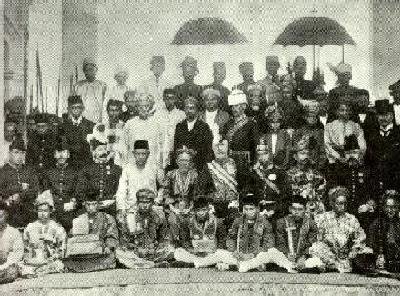
    Photo:The first ever meeting of the Conference of Rulers,held in Kuala Kangsar in 1897

    His house is untidy, even dirty but he bathes twice a day, and is very fond of personal adornment in the shape of smart clothes.

    A Malay is intolerant of insult or slight; it is something that to him should be wiped out in blood. He will brood over a real or fancied stain on his honour until he is possessed by the desire for revenge. If he cannot wreak it on the offender, he will strike out at the first human being that comes in his way, male or female, old or young. It is this state of blind fury, this vision of blood, that produces the amok. The Malay has often be called treacherous. I question whether he deserves the reproach more then other men. He is courteous and expects courtesy in return, and he understands only one method of avenging personal insults.

    The spirit of the clan is also strong in him. He acknowledges the necessity of carrying out, even blindly, the orders of his hereditary, chief, while he will protect his own relatives at all costs and make their quarrel his own.

    The giving of gifts by Raja to subject or subject to ruler, is a custom now falling into desuetude, but it still prevails on the occasion of the accession of a Raja, the appointment of high officers, a. marriage, a circumcision ear-piercing or similar ceremony. As with other Eastern people, hospitality is to the Malay a sacred duty fulfilled by high and low, rich and poor alike.

    Though the. Malay is an Islam by profession, and would suffer crucifixion sooner than deny his faith, he is not a bigot; indeed, his tolerance compares favourably with that of the professing Christian, and, when he thinks of these matters at all, he believes that the absence of hypocrisy is the beginning of religion. He has a sublime faith in God, the immortality of the soul, a heaven of ecstatic earthly
    delights, and a hell of punishments, which every individual is so confident will
    not be his own portion that the idea of its existence presents no terrors.Christian missionaries of all denominations have apparently abandoned the hope of his conversion.

    In his youth, the Malay boy is often beautiful ... a thing of wonderful eyes, eyelashes, and eyebrows, with a far-away expression of sadness and solemnity, as though he had left some better place for a compulsory exile on earth.Those eyes, which are extraordinary large and clear, seem filled with a pained wonder at all they see here, and they give the impression of a constant effort to open ever wider and wider in search of something they never find. Unlike the child of Japan, this cherub never looks as if his nurse had forgotten to wipe his nose. He is treated with elaborate respect if he so desires, eats when he is hungry, has no toys, is never whipped, and hardly ever cries.Until he is fifteen or sixteen, this atmosphere of a better world remains about him. He is often studious even, and duly learns to read the Koran in a language he does not understand.

    Then, well then,. from sixteen to twenty-five or later he is to be avoided. He takes his pleasure,. sows his wild oats like youths of a higher civilisation, is extravagant, open-handed, gambles, gets into debt, run away with his neighbour's wife and generally asserts himself. Then follows a period when he either adopts this path and pursues it, or, more commonly, he weans himself gradually from an indulgence that has not altogether realised his expectation, and if, under the advise of older men, he seeks and obtains a position of credit and usefulness in society from which he begins at last to earn some profit, he will from the age of forty, probably develop into an intelligent man of miserly and rather grasping habits with some one little pet indulgence of no very expensive kind.

    The Malay girl-child is not usually so attractive in appearance as the boy, and less consideration is shown to her. She runs wild till the time comes for investing her in a garment, that is to say when she is about five years old. From then, she is taught to help in the house and kitchen, to sew, to read and write, perhaps to work in the padi field, but she is kept out of the way of all strange menkind. When fifteen or sixteen, she is often almost interesting; very shy, very fond of pretty clothes and ornaments, not uncommonly much fairer in complexion than the Malay man, with small hands and feet, a happy smiling face, good teeth, and wonderful eyes and eyebrows - the eyes of the little Malay boy. The Malay girl is proud of a wealth of straight, black hair, of a spotless olive complexion, of the arch of her brow - ;like a one-day-old moon" - of the curl of her eyelashes, and of the dimples in cheek or chin.

    Unmarried girls are taught to avoid all men except those nearly related to them. Until marriage, it is considered unmaidenly for them to raise their eyes or take any part or interest in their surroundings when men are present. This leads to an affectation of modesty which, however over-strained, deceives nobody.

    After marriage, a woman gets a considerable amount of freedom which she naturally values. In Perak a man, who tries to shut his womankind up and prevent their intercourse with others and a participation in the fetes and pleasures of Malay society, is looked upon as a jealous, ill-conditioned person. Malays are extremely particular about questions of rank and birth, especially when it comes to marriage, and mesalliances, as understood in the West, are with them very rare.

    The general characteristics of Malay women, especially those of gentle birth, are powers of intelligent conversation, quickness in repartee, a strong sense of humour and an instant appreciation of the real meaning of those hidden sayings which are hardly even absent from their conversation. They are fond of reading such literature as their language offers, and they use uncommon words and expressions, the meanings of which are hardly known to men. For the telling of secrets, they have secret modes of speech not understanded of the people.

    They are generally amiable in disposition, mildly - sometimes fiercely - jealous, often extravagant and, up to about the age of forty, evince increasing fondness for Jewellery and smart clothes. In these latter days they are developing a pretty taste for horses, carriages, and whatever conduces to luxury and display, though, in their houses, there are still a rugged simplicity and untidiness, absolutely devoid of all sense of order.

    A Malay is allowed by law to have as many as four wives, to divorce them, and replace them. If he is well off and can afford so much luxury, he usually takes advantage of the power to marry more than one wife, to divorce and secure successors; but he seldom undertakes the responsibility of four wives at one time. The woman on her part can, and of ten does, obtain a divorce from her husband. Written conditions of marriage, "settlements" of a kind, are common with people in the upper classes, and the law provides for the custody of children, division of property, and so on. The ancient maiden lady is an unknown quantity, so is the Malay public woman; and, as there is no society bugbear, the people lead lives that are almost natural. There are no drunken husbands, no hobnail boots, and no screaming viragoes - because a word would get rid of them. All. forms of madness, mania, and brain-softening are extremely rare.

    The Malay has ideas on the subject of marriage, ideas born of his infinite experience. He has even soared into regions of matrimonial philosophy, and returned with such crumbs of lore as never fall to the poor monogamist.I am not going to give away the secrets of the life behind the curtain; if I wished to do so I might trip over difficulties of expression; but in spite of the Malay's reputation for bloodthirstiness, in spite of (or because of, whichever you please) the fact that he is impregnated with the doctrines of Islam, in spite of his sensitive honour and his proneness to revenge, and in spite of his desire to keep his own women (when young and attractive) away from the prying eyes of other men, he yet holds this uncommon faith, that if he has set his affections on a woman, and for any reason he is unable at once to make her his own, he cares not to how many others she allies herself provided she becomes his before time has robbed her of her physical
    attractions.His reason is this. He says (certainly not to a stranger, rarely even to his Malay friends, but to himself) "if, after all this experience, she like me best, I have no fear that she will wish to go further afield. All Malay girls marry before they are twenty, and the woman who has only known one husband, however attractive he may be, will come sooner or later to the conviction that life with another promises new and delightful experiences not found in the society of the first man to whom destiny and her relatives have chosen to unite her. Thus some fool persuades her that in his worship and passion she will find the World's Desire, and it is only after perhaps a long and varied experience that she realises that, having started for a voyage on the ocean, she finds herself seated at the bottom of a dry well'.

    It is possible that thus she becomes acquainted with truth

    source: http://www.sabrizain.demon.co.uk/malaya/malays2.htm

    Sunday, July 31, 2005

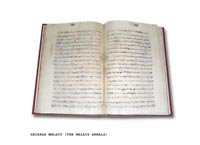
    Sejarah Melayu (The Malay Annals)


    I had a hard time in the last few months searching for The Sejarah Melayu or the Malay Annals. O Yes at last I found them in Dewan Bahasa bookshop.. the luxury version will cost me a bomb, what with leather bound et all, and the cheaper version are from the STPM series. Even then there are claims that the cheaper version may have differences in facts. So what is so special about the Sejarah Melayu?

    Sejarah Melayu(Malay Annals) is clearly the most famous, distinctive and best classical Malay prose to be ever produced, sharing in the great literary tradition other Malay works such as the Hikayat Hang Tuah, Hikayat Raja-Raja Pasai and the Hikayat Merong Mahawangsa. It chronicles the establishment of the Malaccan sultanate, charting a course of more than 600 years in a solid compact book filled with intricate details regarding royal protocol, royal lineages, weaving in various historical, mythical and legendary figures and episodes in a compendium that still captivates its audiences three centuries later.

    The Sejarah Melayu or Malay Annals are unique in that they constitute the only available account of the history of the Malay Sultanate in the fifteenth and early sixteenth century. They are in the nature of what may be termed as historical literature conveying a historical narration on the origins, evolution and demise of a great Malay maritime empire, with its unique system of government, administration and politics. The Annals have universal appeal as they relate to a major transformation in the lives of the people of the Malay Archipelago from a Hindu-Malay matrix to an Islamic – Malay culture. Being an entrepot port, Melaka made rapid progress on account of its cosmopolitan population comprising merchants from India, China, Arabia, Portugal and various other nations of the world. They contributed to the social, economic and political evolution of the Malay Kingdom.

    The main theme of this work was to laud the greatness and superiority of the Malaccan state, which had been founded about 1400. Although the Sejarah Melayu mentions only one date, events described in it can be verified by other historical sources. The Sejarah Melayu consists of a collection of stories, not historically connected, focusing on the activities of the Malaccan sultans, their courts, and government officials. In addition, foreign rulers were also described, as were Malacca's foreign relations and its importance as a regional trading centre. A noteworthy omission was the absence of any mention of peasant life. The Sejarah Melayu is significant for its well-written narrative and characterization of personalities, and it is also an important historical source about Malacca and the Malay world prior to Malacca's defeat by the Portuguese in 1511.

    Attributed to Tun Seri Lanang as its first editor, the work was commissioned by Sultan 'Ala'u-d-din Ri'ayat Shah of Johor. It was claimed to have been begun in on Sunday May 13, 1612, in Pasai, Sumatra, where the Sultan was being held captive Mahkota Alam of Acheh. However, some scholars think that the original text was written prior to 1536 and underwent changes in 1612.

    The main aim of this work was, undoubtedly, to laud the spleandour, greatness and superiority of the Melaka Sultanate - and it was written at a time when the Johor court, successors of the Melaka sultans, were being attacked by Portuguese and Achinese, their capital sacked many times and having to be moved from one part of the Straits to another. The court was frequently on the run from marauding invaders, their territories being overrun. The Sejarah Melayu was probably an attempt by the Johor court to overcome its sense of lost fortunes by regaining the past glories of a mythical golden age that was less than a generation past. It still serves to inspire the Malay of today - and to remind them of the heights that they can be, and have been, capable of reaching.

    source:
    http://www.sabrizain.org/malaya/malays1.htm
    http://www.britannica.com/eb/article-9066639

    Saturday, July 02, 2005

    Enrique of Melaka : Was the first man to sail around the world a Malay

    I read an interesting article reproduced here on the theory that a Malay and not Magellan was the first person toe sail around the world....who is this Enrique?

    some answer from everything2.org
    Enrique de Malacca, also known as Enrique Negro, Black Henry, or Panglima Awang, was possibly the first person to circumnavigate the earth.When he was a 13 year old boy, in Malacca on the Malaysian peninsula, he was captured and enslaved by Ferdinand Magellan, at some point around the year 1500. In 1519 Magellan's expedition set out to discover a route sailing west from Spain to the Moluccas, or Spice Islands. When the expedition reached the Visayan islands of the Philippines, Enrique was able to communicate with the islanders. Magellan was killed on the island of Mactan, betrayed by the Spanish officers in his service. Enrique then betrayed the officers to Humabon, Rajah of the neighboring island of Cebu, and jumped ship. The question is, did Enrique know the language of the islanders, or did they know Malay, a popular trade language? The impression from Pigafetta's journal is that Enrique was communicating fluently with the islanders of Cebu. If this is true, it's possible that he, not Juan Sebastian Del Cano, Antonio Pigafetta, and the other 16 survivors of the expedition, was the first to go all the way around the world. http://everything2.org/index.pl?node_id=1103828

    Photo:Magellan, from acontemporary painting


    Over the years, there has been considerable debate about who actually was the first man to sail around the world. We were all taught this historic honour belongs to Ferdinand Magellan (Fernao de Magalhaes, in his native Portuguese)who led the expedition of five ships and over 270 men out of Spain in 1519 and sailed westwards, reaching the Philippines, where he was killed. However, Magellan was thought to have travelled to as far as Sabah before, and one can argue that he had indeed actually completed circumnavigating the globe. Thereare also those who argue that the accolade should rightly belong to Sebastian del Cano, a mutineer from Magellan's crew, who led the one surviving ship, Victoria, and 17 other men, and limped back to Spain on September 8, 1522.

    However, only one individual can truly claim to have been the first man to leave his home, sail around the globe and arrive at a part of the world where his mother tongue was spoken. That man was a Malay, Magellan's able servant and interpreter, called Enrique of Melaka or Henry the Black.

    If there is any single Malay ever who has had the greatest impact on world history, it would probably be Enrique and we know so little of the man. He is called Panglima Awang in Malay literature but there is no mention of him in any credible Malay historical records. There is brief mention of Enrique in the official Spanish crew lists, as well as Magellan's last will and testament. Almost all of the certain facts that we know of Enrique come from the most comprehensive chronicle of Magellan's voyage, the narrative by Antonio Pigafetta, an Italian volunteer who joined Magellan's crew.

    Pigafetta does briefly mention Enrique's origins - he was a Malay who had lived in Melaka but was originally from 'Zamatra' (Sumatra). Magellan was among the crew of the Portuguese squadron of five ships under Diego Lopez de Sequeira which sailed into Melaka on September 1, 1509, and became the first Europeans to have contact with the Malay Peninsula. Magellan also took part in the capture of the city by the Portuguese in 1511 and it was probably then that he acquired a Malay slave, whom he gave the name Enrique.

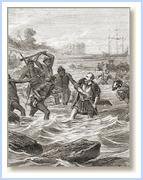
    Photo:The Death of Magellan, from
    a 19th century illustration

    The young Enrique may have been about 18 at the time - Magellan's will and testament made eight years later cited Enrique as being "of the age of twenty-six years, more or less". The will also stated specifically that Enrique was a "captured slave" - indicating that Enrique was not bought in a slave market by Magellan. There were thousands of slaves in Melaka belonging to the merchants and Malay nobility, and Portuguese records indicate that Sultan Mahmud of Melaka alone had over three thousand 'hambarages' ('Hamba Raja' or royal slaves). Many were in fact prisoners of war brought back from Melaka's successful campaigns against the kingdoms of Sumatra, Enrique's birthplace.

    Enrique must be a guide and interpreter when Magellan travelled to different parts of the East Indies after Melaka's capture, reaching as far as Sabah. He then sailed back to Lisbon in 1512, with his loyal Malay servant in tow, and was dispatched to the Portuguese campaigns against the Moors in Morocco. Magellan was later accused of corruption left the service of the King of Portugal and offered his services to King Charles I of Spain in 1517. Magellan presented the King of Spain with his plan - to find a route sailing westwards to the Spice Islands, avoiding the Portuguese. It is said that he even had Enrique presented to the King to convince that he a man with the local language, knowledge and experience will make the voyage a success.

    Magellan later declare in his will and testament that, upon his death, Enrique “shall be free and manumitted, and quit, exempt, and relieved of every obligation and subjection, that he may act as he desires and thinks fit.” Magellan even left Enrique a comfortable share from his estate, “the sum of ten thousand maravedis in money for his support”

    The Spanish king agreed and Magellan was provided with five sailing ships - San Antonio, Conception, Victoria, Santiago and his flagship Trinidad -
    and crews comprising over 270 men. They left the Spanish port of Sanlucar de Barrameda on September 20th, 1519 and began the daring and historic voyage of exploration ever - a voyage equaled to Man's landing on the moon 450 years later.

    Across the Atlantic, down South America and across the Pacific, they sailed and finally, on March 16th , 1521 they sighted Samar, the most easterly of the Philippine islands. But on March 28th, a momentous event occurred. Pigafetta wrote: “.... we saw approaching two long boats, which they called Ballanghai, full of men, and in the larger was their king seated below an awning made of mats. And when they came near the captain's ship, the said slave (Enrique) spoke to that king, who understood him well.”

    As they continued their voyage to the surrounding island kingdoms, it was Enrique alone who, on behalf of Magellan and the Spanish crown, spoke with kings and traders. Magellan had befriended the ruler of Cebu, Raja Humabon and was asked to punish rebellious natives in Mactan, under a warrior named Lapu Lapu. On Saturday, the 27th of April, Magellan attacked LapuLapu's with 60 men-at-arms - cannon, muskets, crossbows and steel swords against bamboo spears and poison-tipped arrows. But the small Spaniard force suddenly found itself overwhelmed by over 1,500 of Lapu Lapu's warriors.

    Pigafetta noted that Lapu Lapu's men were converging their attacks on the Spanish captain himself - Magellan was first struck in the right leg by an arrow and later a spear stabbed him in the arm. For some reason, his cannon had now stopped firing and, despite being pressed by attacks for nearly an hour, no reinforcements had arrived from his waiting ships. Wading knee-deep in the surf, he was finally pierced by a spear in the right leg and he collapsed face down dead.

    Enrique himself was wounded in the battle. Pigafetta writes that “he no longer went ashore to do necessary business but was always wrapped in a blanket” A new commander replace Magellan - a Portuguese by the name of Duarte Barbosa. Shouting at Enrique, Barbosa told him that although his master was dead, he was not to be freed but was to remain a slave.

    Pigafetta writes that Enrique went ashore and told Humabon that the Spaniards were about to depart immediately “but, if he would follow his advice, he would gain all their ships merchandise ... and so they plotted a conspiracy.”

    The next day, Enrique told the Spaniards that Humabon had prepared jewels and presents asked them to come ashore to receive these. A party of Spaniards led by Barbosa did come, accompanied as usual by Enrique, but they were attacked. A lone survivor fled back towards the ships and, when asked if there were any others who survived the attack, he said all were dead, except the interpreter, Enrique.

    Official Spanish records list Enrique of Melaka as one of the 27 men massacred in that attack, so we really do not know if Enrique did survive that attack, as Pigafetta claims. What we do know is that was the last we hear of Enrique in Pigafetta's diary - and he disappears into the mists of history. If Enrique had indeed made his way home from Cebu he would be the first man ever to have sailed around the world, rather than Magellan or del Cano.

    One could also argue that the Spaniards may have indeed changed the official crew lists to ensure that this was not a possibility - how could a Malay slave have beaten the flower of Spanish manhood in the race around the globe? Certainly, Enrique was to be just a footnote to the heroic deeds of Magellan and del Cano that were told in countless books about this remarkable voyage written over the next few hundred years. Little was known about him even in Malaya until, in 1958, the writer Harun Aminurrashid published one of the greatest historical novels in modern Malay fiction, "Panglima Awang".

    Despite Pigafetta's quite clear statement that he was from Sumatra, Filipino writers and historians are now claiming Enrique as one of their own countrymen. The most convenient feature of these theories is that if Enrique was indeed from Cebu, that would without any doubt make a Filipino the first man to have sailed around the world.

    The main argument behind these theories is that Enrique could speak in the language of the people inhabiting the islands around Cebu - Bisayan - and therefore must have been from Cebu himself. There is a fatal flaw in this argument - Pigafetta's narrative above does show that Enrique could not communicate at all with the natives in his first encounter with them. It was only when he spoke with royalty - in this case, their king - or with traders that they suddenly found a common language among them. This is certainly not surprising - Malay was, by then, the 'lingua franca' of the whole Archipelago, and the official language of international diplomacy and trade for the whole region. All references to Enrique in Pigafetta's chronicle have him speaking with kings, chiefs or traders - rather than the common folk who may not have known the international language of Malay.

    Enrique of Melaka had sailed the seas of the East Indies with his master; followed him across the Indian Ocean and around the rim of the African continent; loyally fought alongside him in North Africa; lived in the splendour of the royal courts of Portugal and Spain. He embarked upon the greatest adventure ever - to circle the globe, the final frontier; to explore strange new worlds; to seek out new life and new civilizations; to boldly go where no man has gone before.

    Having done that, he had returned full circle, to a land where he could understand the people and they could understand him. And there is just still the possibility that this humble Malay slave was indeed the first human ever to have sailed around the world.


    Pigafetta, Antonio, journal, quoted in Skelton, R.A., 'Magellan's Voyage--A narrative Account of the First Circumnavigation', New Haven: Yale University Press, 1969
    Zweig, S. Magellan. 'Der Mann und seine Tat', Wien-Leipzig-Zürich, 1937 and Fischer Taschenbuch Verlag, 1983
    Pintado, M J, 'Portuguese Documents On Melaka', National Archives of Malaysia, 1993.

    for more details please follow this source: http://www.sabrizain.org http://www.sabrizain.org/malaya/port3.htm

    Saturday, June 11, 2005

    Malaysia has a lot of use for that school in Kuala Kangsar


    Malaysia has a lot of use for that school in Kuala Kangsar
    [Berita MCOBA Vol. 2 No. 1 March 1991]by Rehman Rashid

    You and I, fellow Collegian, are part of the ‘Malay College Mafia’ that’s being whispered about these days. Indeed, the Malay College Old Boys’ Association has become the nearest thing to a masonic lodge this country’s ever known outside the Chinese clans. MCOBA is a code with special access into every corner of governance in Malaysia: the government, the civil service, the private sector, academia, the palaces, everywhere. Old Boys of the Malay College can be found among the country’s foremost politicians, administrators and businessmen, bankers, doctors, lawyers and engineers. It remains the school of royalty. Not because the sons of the Sultans still study there – they do not, for valid enough reasons – but because their fathers once did.

    The Malay College stands tall in the national conscience – even, perhaps especially, among those who never went there. Abdul Kadir bin Jasin, Group Editor of the New Straits Times, recently wrote about his feeling of inferiority at not having attended
    one of the nations’ top residential schools: you’re not so eager to tell people where you went to school. But even a char koay teow seller is elevated by being an alumnus of the Malay College. (Yes, it remains possible to be an MC Old Boy and never know wealth or position. We are not all as rich and powerful as the richest and most powerful of us are. But the qualities remain the same. Diamonds in the dust sparkle just as brightly as those on a crown. Or a Rolex.)Why? Simple: Because MC was a good school, enrolling the best of Malay youth, having them live and compete with each other as equals, giving them good teachers and splendid playing fields. But let’s see what this means.

    Let’s attempt a definition:The Malay College is the most important school in
    Malaysia, because it’s the most important school for the Malays. Unconscionable arrogance? Of course. It is a grotesque overstatement of the point: the greatest strength of the Malay College is that it teaches pride. And pride is the one thing the Malays have been striving throughout history.

    The NEP is about nothing else. It is simply today’s stage of the process that began
    with Onn Jaafar cycling through the hinterland in 1946: the crusade to lift the
    Malays out of their humble, dispirited, apathetic inertia and ensconce them on a
    plane of dignity in their own country – a country that they had never been able
    to save from foreign conquerors. The Portuguese, the Dutch, the British, the
    Japanese, the British again... oh those damned British ! ...And now the Chinese,
    whom too many Malays remain wary of regarding as fellow countrymen. Today’s Malay political ethic – and this feverish battle for dominance- stems from there having nothing but humiliation in the past five hundred years of Malay history.

    And what was Parameswara himself but a fleeing refugee from Temasik.
    The Malays of Malaysia have no heroes to compare with the national deities of
    Indonesia, for example. (Indeed, for the example that matters most.) We have no
    Iskandar Thani, no Cut Nyak Dien or Singgamarajah. No Hatta or Sukarno or
    Kartini. No martyrdom ever bloodied our soil, no valour stood triumphant in war.
    Why else this endless fuss about Hang Tuah and Jebat, a pair of melancholy
    poseurs with long libidos and short tempers?

    The Malay concept of heroism is fatally flawed in this one regard: it celebrates the defenders of the throne, exalting loyalty, and not the focus of the loyalty: the throne itself.

    History reserves heroism for conquerors, regardless of whether they are
    brutal or enlightened. But the various Malay States were never united under one
    emperor king; on the contrary, they were fromed in the dissolution of the
    biggest single Malay state in our past – Malacca – and spent their subsequent
    sovereignties squabbling. What we long to remember as the Golden Age of the
    Malays was in fact a drawn – out decline. We were never conquerors, only the
    conquered, and that galls many Malays today
    . Hence this political obsession with the need to be vigilant against losing everything to the Outlanders. Ensuring
    Malay pre-eminence – cultural, linguistic and parliamentary – is the central theme of Malay politics. It is really the fear of Malay eclipse; hence the durability of Hang Tuah’s famous utterance about the Malays never vanishing from the world.
    The Malays’ greatest weakness is their sense of weakness. The aggressiveness now associated with Malay leadership stems from an ingrained inferiority complex. ("You don’t know what it’s like," Dr. Mahathir once told me in a recorded interview, "to be considered on par with dogs and other animals.")This is not a common weakness, however, among those who went to Malay College.

    The Malay College was singularly effective in curing its students of their sense of inferiority. Since its earliest years, the school has brought together young Malay men from every state, rich and poor, aristocrats and commoners, and educated them to the highest standards expected of them. In the process, three important truths were revealed to every boy who went to Kuala Kangsar on his first journey away from home and family:

    First, intelligence had nothing to do with birth or breeding.
    Second, there was indeed a unity of Malay states.
    Third, education was synonymous with leadership;
    there could not be one without the other, if either was to be done right.

    In teaching them to respect quality, ability and excellence (and having it proven year after year in examination halls and on playing fields alike), the Malay College raised its boys to see themselves as equal of their country’s greatest conquerors. The English-ness of the Malay College – all that Eton-of-the-East business – reached
    its height in the Forties and Fifties, when the Fives Court was actually in use. Old Boys of that vintage must look back at their youth with a mixture of fond nostalgia tinged with a little embarrassment at those very pukka times. (In William Shaw’s biography of Tun Razak, there is a 1948 photo of Tun and a few friends in London. In stylish tweed suits they elegantly pose in St. James Park, each of them holding a pipe in the style Sherlock Holmes made famous.) But the Anglicisation was never quite as complete as it may have seemed to passers-by on Station Road or the Strand. For one thing, these were intelligent and well-educated young men, living in the heart of Empire during a time of great global change and intellectual energy. Giants walked the earth: the Churchills, Roosevelts and MacArthurs of the West giving ground to the Gandhis, Nehrus, Sukarnos, Chou En Lais and Ho Chi Minhs of Asia, as the British Empire,blown to smithereens by the Second World War, crumbled before the rising tide of history. To be young, bright and Malayan in London at such a time must have been to feel part of a great rebirth: to be the fledgling leaders of a new world of many nations where once there were only the empires of a few.And there
    was something else, too, that served to continually remind these young, elite and English-educated mean of their Malayness. "You felt like a fool at their parties," says one who remembers, "standing around with your orange juice while they were all drinking gin and tonics and talking to themselves."

    What was irritating about this was not the inability to do everything the British way, but the perception that the British would always look down on those who did not. This irritation has persisted, because the British are notoriously slow to relinquish their historical pride, and we are notoriously slow to acquire ours. I believe this explains Dr. Mahathir’s remarkable campaign to settle scores with the British the moment he became Prime Minister. The Carrington snub, the Buy-British-Last policy, and the final triumph of his first official visit to Britain in 1987: the attention of Mrs. Thatcher and instant tickets to a West End musical with a six-month-long waiting list. Ironically, those Malays of Mahathir’s generation who received a British education are less impressed by Britain’s standards. Those educated at the Malay College began meeting those standards at the ages of ten or twelve.

    When you know you are the equal of your conqueror, he is your conqueror no longer. He may be big, you may be small, but you both know your minds are equal. So you set aside the machinery of conquest, tell your bodyguards to wait outside and keep the peace, and start using your brains. You talk, negotiate, deal for what you both want. When your negotiations are successful, you know you have moved beyond barbarism. You are civilised men. The architects of Malayan Independence were conquerors too. But their weapons, with which they regained a country that had been lost to us for 450 years, were ideas. Not the Tamingsari, the kris of Hang Tuah, that ubiquitous symbol of Malay power; which as recently as October 1987 was still being proclaimed thirsty for Chinese blood. There were Malays among those men of Independence, as there were in the highest echelons of the first national administration of Malaya. Many of them were Old Boys of the Malay College. But because MC was founded to create an administrative elite, and because that ethic predated the emergence of politics in this country, relatively few
    Old Boys have become politicians. The persistent need for ‘grassroots’ support
    is partly to blame – College boys have long tended to leave their kampungs
    behind once they’ve been through Prep School. Also, I feel, Old Boys are
    inherently uncomfortable with the premise that political power is the only
    defence against the Chinese because they’re shrewder, smarter, harder-working
    and generally better than the Malays at everything else. College boys tend to
    consider themselves capable of being as shrewd, smart and successful as anyone.
    They’ve been taught to believe they can do anything as well as anyone and God
    knows better than most.

    Those who regard the Malay College as a self-important bastion of neo-colonialism despise us for this. They see the Malay College as having done nothing but turn out generations of smug Anglophilic Melayus sneering at their peasant ancestors, while the foreigners were freely looting their lands. Malay College boys may have thought they were the leading edge of their people, but in fact they were leaving their people entirely behind. It is not an invalid view. But I prefer to regard those cocky brown men with their clubby English accents, proudly wearing their little white wigs at the Inns of Court, as having learned how to negotiate the return of a purloined booty. The crowning moment of that skill was, and remains, Merdeka Day 1957. But fundamental to Independence was the success of the UMNO-MCA-MIC Alliance. Independence could not have been won without the political linkage of the Malays, Chinese and Indians of Malaya. Negotiating that
    linkage could only have done by the top men if each community, those versed in a
    common voice. Speaking on behalf of the Malays, ensuring their primacy in the
    Alliance and laying down so strong a defence that Malay political pre-eminence is today unchallenged, were many Old Boys of the Malay College. One of them, Abdul Razak bin Hussein, will be remembered as Malaysia’s first truly significant Prime Minister. Tunku Abdul Rahman, Bapa Malaysia, was an appointed representative. He was so full of happy linkages. A royal prince chosen by his people, fond of the Chinese and Indians and accepted as the best possible interface between them all. Tunku was legendary for being the most Anglophile Malay of his time – a dilettante aristocrat with a fondness for sports cars, horses and English university towns in autumn.

    Tunku’s premiership was as the Chief Malayan Witness to the end of Empire. He was a sweet, gentle and hopeful way to say goodbye to the old order. It was left to Tun Razak, Bapa Pembangunan, to design the blueprint for the new.
    And how’s this for iron: The NEP, designed to elevate the Malays, was responsible for the rapid decline of the Malay College, which had done so much to make the NEP possible. In an astonishing display of wrong-headedness, the qualities of the Malay College were deemed detrimental to Malay pride.

    I was still at the College in the early Seventies, when the Education Minister at the time, Musa Hitam, declared "elitism is out". (The statement was made in Hargreaves Hall, during that year’s Speech Day. Musa had prefaced it however, with the statement that he had always wanted to attend Malay College, but had to settle for Johore’s English College instead.)"Elitism", in the sense Musa intended, referred to the grooming of a few selected Malays to stations above the mass of their people. This was apparently unjust. The Malay College had to be no different from other schools. Had that signified an intention to raise all schools to Malay College standards, it would have been laudable (if a bit far-fetched). But the most important thing was uniformity, "equal opportunities," and if other schools could not be raised to the stature of MC, MC would be lowered to the level of other schools. And then Headmasters began coming and going every couple of years, and the turnover of teachers trebled. Times changed very rapidly. Today the College no longer has a Sixth Form, (for reasons brilliantly perceived in a prescient essay by Ramli Mohammad in the College Magazine, Vol. VII No.3, 1973.) Standards declined precipitously. Because they were doing so across the board in Malaysian education, which was struggling to accommodate the new expectations of the NEP, the College retained its reputation as one of the best schools in the country. But that was relative to other schools, and not to the standards the College had traditionally set itself. Now, after nearly twenty years and the active involvement of MCOBA, the decline has been arrested.

    We now hear the Sultan of Kedah call for the formal recognition of the College as a leading institution. An adulatory story on the College appears in the ‘Tatler’, of all places. And the ‘Malay College Mafia’ is now perceived as increasingly influential at all levels of Maalysia’s government and economy. ‘Elitism’, it would appear, is back with a vengeance. But then it had never gone away. What was once decried as ‘elitism’ the elevation of some above others – is now recognised as the process by which leaders emerge. As long as a nation needs leaders there will be a need for schools in which good minds are encouraged to reach for glory, recognising no limits to their potential other than those imposed by decency, discipline and compassion for the less favoured.

    The Malay College has traditionally turned out men with a sense of responsibility to things greater than themselves, which is perhaps another reason for MCOBA’s rosters being notably short on politicians. But not on managers (a category in which I include all good businessmen, administrators and successful people in general). Successful management requires copious measures of the qualities MC has been known to cultivate: a vision of the Big Picture, and understanding of hierarchies and networks, a keen sense of identity and much self-confidence.

    Good management is impossible without such qualities, but the worst management emerges when those in authority know they are not there because of their professional competence. This is why there are pejorative overtones to the word ‘elitism’ – it can also mean elevation for reasons other than ability and merit.
    Such positions are political, and those occupying them know that their tenures have little to do with how they do their jobs. This is a fearful state to be in, and doing their jobs becomes secondary to serving the connections that are keeping them there.
    I see this as part of the reason for the mediocrity that has come to afflict so many Malay ventures in both the public and private sectors. Success can only be measured in merit. That is as true in management as it is in the classroom, exam hall or on the running track – or Benches of Parliament.

    The NEP may be a step towards leveling the playing field for a true meritocracy to emerge in Malaysia, at which time the Malays can be said to have ‘arrived’. But while anxious gazes are fixed on the future, many seem to have forgotten that the Malay College has been a meritocracy since its inception. Thanks in part to schools like MC, the Malays are not entirely alien to success honestly earned and well deserved. Out of that comes pride, and out of that pride comes the confidence the Malays need if they are to negotiate constructively with their fellow countrymen –
    especially those their politicians claim to distrust and fear. Much of that fear is cynically inflated for the sake of ‘Malay unity’, but it is nonetheless rooted in that damnable inferiority complex. That fear, while doing obviously nothing for Malay unity, has earned us the scorn of the non-Malays. But when the Chinese in particular realise that the Malays have begun losing their fear of being economically stripped, and are instead ready and able to deal intelligently with their partners as equals, there will be a burgeoning of opportunities to do so.

    This allows me to end this discourse on an optimistic note, for I believe the process is well underway. We can be certain that in boardrooms and corner office suites across the region, exemplary Malay executives, intellectuals and professionals are doing the talking on behalf of their people, thinking well, speaking intelligently and looking good; making the Malays look good and winning the confidence and respect of their
    partners.

    We can also be sure that some of them are known to wear a certain striped tie on Wednesdays, deriving from that one item of apparel all the evidence they need of their capacity for success.

    It would be nice to hope there are some politicians in them.

    source:http://us.geocities.com/mckknet/article-13.htm

    Sunday, May 29, 2005

    If They Would Only Stop Putting Those Ugly Ties On


    Somehow I always like this article. I guess it represent the views of most adult who sees someone wearing that ugly maroon tie. As for me, I used to wear it without fail every wednesday during those days when I frequently go up and down MINDEF ( Ministry of Defence). Just to rub it on those OP (Old Putra) blokes. At least I get to know a few of them when we were stuck in the lift. Its something to start a conversation. Well the OP and the friends of this Jockstrap guys are not all bad. We do get along well, at the end of the day I believe our aim is similar......

    If They Would Only Stop Putting Those Ugly Ties On [STAR86 Online]by Jockstrap Giles

    It is a bit sad that these old MC sods have the weekly need to wrap a piece of striped rag around their greasy necks just to tell the world that they all spent their pathetic pubescent years in one same place. We would naturally then be compelled to presume that their lives have been shamefully reduced to such ugly ties, which incidentally went outdated the last time a Hanoverian sat on the Throne.

    Funny thing is, without those moth-eatened ties around their dirt-stained necks, they can be ironically tolerable. When I took those momentous steps down the matrimonial aisles, my Best Man was an old MC type. And I was even called upon to be the best man for two of their kind. My regular Friday Prayer / Lunch Chum is also one; and depending on circumstances, we are sometimes joined by another one or two (along with some Old Grand STARians). Then there is this kilogramme-endowed mass of a bloke with whom I share the passion for intellectual wit and during my bachelor days of yore, very non-intellectual audio-visual materials.

    Perhaps some twist of Fate dictated that the food and quasi-drinking water which were forced down our throats in Ipoh and KK actually came from the same source -therefore some of them get along well with some of us. Just as long as we don't bump into them on one of their Ugly Tie Days. I'm certain that even if G. Versace had the chance, his fashion instinct would have told him not to go to MC. Then again, his hormonal instinct most probably would!

    But just imagine, if only those tie straps were spaced out a bit, and alternated with rows of majestic badges, they would be quite a classic.

    Friday, May 13, 2005

    "May 13 - Before and After"

    "May 13 - Before and After"Excerpts of this book by (the late) Tunku Abdul Rahman, then Prime Minister of malaysia, published in September 1969
    "Victory" on the rampage
    No one was more surprised, I am sure, than the DAP and the newly-formed Gerakan with their unexpected successes. They felt not only cocky, but downright arrogant. They lost no time in arranging to celebrate their "victories." Dr. Tan Chee Khoon, who won his seat in Batu Selangor, with a big majority asked for Police permission to hold a procession by members of his Gerakan Party. A permit was granted on condition that it followed a route authorised by the Police. (On 12th May) Dr. Tan's victory procession was held on an unprecedented scale, politically speaking, and was accompanied by acts of rowdyism and hooliganism and in utter defiance of the Police after the main procession had ended.The procession went through unauthorised routes, jamming traffic everywhere as a consequence. With victory emotions on the loose and - there can be no other explanation - Communists urging them on, the victors made a serious blunder, and blunder it was. The procession shouting its way along turned into Jalan Campbell and Jalan Hale - roads on the edge of an leading into Kampong Bahru where 30,000 Malays have lived in peace for years beneath the palms in their own settlement in the centre of Kuala Lumpur.


    Jalan Hale is the main street of Kampong Bahru. There they proceeded to provoke the Malays, gibing at them and throwing their victory in their faces in the midst of what is virtually an UMNO stronghold.On Tuesday, May 13th Gerakan Party's Yeoh Tech Chye, the President of the Malaysian Trades Union Congress (who won big in Bukit Bintang, Kuala Lumpur) made an open apology in the press for his party supporters having caused such inconvenience to the public. But the emotional damage had already been done.

    I (Tunku) returned to Kuala Lumpur about lunchtime from Alor Star. My Principal Private Secretary informed me that he had received news that a counter demonstration was to be held on May 13th as the Malays were very annoyed.UMNO was going to stage a procession to celebrate it's victory and that a crowd would gather in the compound of the house of the Menteri Besar of Selangor, Dato Harun bin Idris, in Jalan Raja Muda and that the procession would start from there. I was personally worried that the procession might lead to trouble. It was not easy to stop it at this stage as the Opposition had already held processions, and permission had already been obtained for UMNO to have theirs.

    May 13th
    ..…A phone call came through at 6.45pm that an ugly incident had taken place along Jalan Raja Muda in which some Chinese were assaulted. Immediately afterwards Enche Mansor, the Kuala Lumpur Police Traffic Chief, and one or two others, came to see me and said that there had been killing. The city had been placed under immediate curfew as at 7 pm.The Security Forces were out, the army called in. Naturally I could not sleep that night, my mind upset with the tragedy that had overtaken our peaceful capital and nation. I went out side my balcony outside my room looking down on the city in the valley by night. Flames were burning high in several areas, near Kampong Bharu and to the North. Kuala Lumpur was a city on fire and it was a sight that I never thought I would see in my lifetime.

    While they were gathered in the compound of Dato Harun's residence news came through suddenly that Chinese had attacked Malays in Setapak, a mile or two to the North, as they were on their way to join the procession starting from Jalan Raja Muda. The news created a storm of indignation; hell broke loose. Two Chinese passing by on motor cycles were attacked and killed. And so the riots of May 13th began, triggering off violence unprecedented in the history of Malaysa. (A state of emergency was declared on May 16th and a National Operations Council set up to deal with all matters pertaining to it. The first act: round-the-clock curfew.)..Within 48 hours it was possible for the Council to approve relaxation in the curfew in many areas of the country. Even in the most sensitive ares, Kampong Bharu and the Jalan Chow Kit sections of Kuala Lumpur, where the violence had originated, it was possible after one week from the outbreak to announce curfew relaxations there.

    There was no insecurity in the East Coast states. In Johore and Negri Sembilan no incidents had occurred at any time. In Malacca there had been a few minor troubles and they had now ceased as quickly as they had started. There were no incidents taking place in Perak and Penang, Kedah and Perlis.Apart from Kuala Lumpur, the only sections in the country needing the strictest vigilance were in the Betong salient, the rural areas along the Kedah and Perak borders with Thailand. The general situation, however, was far from normal, mainly for one particular reason - rumours. During the height of the disturbances rumour-mongering was wild and widespread as always happen anywhere in time of riot.

    http://www.littlespeck.com/ThePast/CPast-My-tunku-030513.htm

    GoogleAd

    LinkWithin

    Related Posts Plugin for WordPress, Blogger...