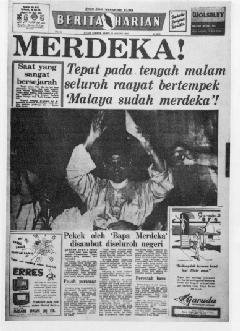
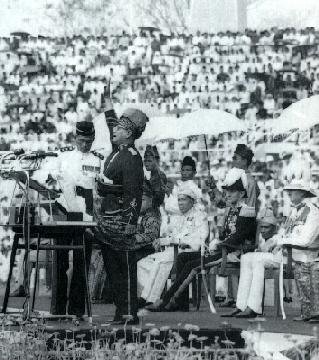
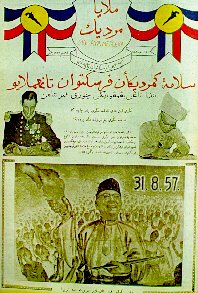
some photos from the past on MERDEKA


 across the Heavens."
 ang.As a mark of respect, honour and appreciation to these four Rulers, the four Houses were named after them, namely Idris (White), Sulaiman (Red), Muhamad Shah (Yellow) and Ahmad (Black).
Her Majesty the Queen of England once called MCKK “
the Eaton of the East” when she visited Malaysia a couple of years ago. It is said His Highness the King of Malaysia then corrected her by calling Eaton “the MCKK of the West”. This, of course, cannot be confirmed but ask any “Old Boy” -- what an ex-Collegian is called though, let me assure you, none of these Old Boys act old -- and they would all agree that Eaton is what it is because they copied the traditions of MCKK.
The Battle of Britain was won on the playing fields of Eaton, they say. Well, Malaya’s independence was won on the playing fields of MCKK. As much as Malaysian Prime Minister Dr Mahathir Mohamad and UMNO try very hard to give the impression that Malaya’s independence was won due to UMNO’s struggle, what the history books fail to mention is that many of those “independence fighters” were products of MCKK. Granted it was a “peoples’ struggle”, but the rakyat, to quote Dr Mahathir, are like a herd. They ju
st follow the leader, and it ne
eded a leader to lead them to independence. And MCKK provided these leaders of independence.
I cannot resist mentioning that many of these early independence fighters like Sir Dato Onn bin Jaffar (Hussein Onn’s father), Dato Abdul Wahab (Dato Panglima Bukit Gantang and one time Menteri Besar of Perak), Dato Laksmana Razali, Tun Aziz bin Abdul Majid (one time Governor of Melaka), Dato Haji Kamaruddin bin Haji Idris (Dato Suhaimi’s father), Tun Abdul Razak (Dato Seri Najib’s fathe
r), Raja Sir Tun Uda (my grandfather), Dato Bahaman, Dato Andika Indera, and so on, were mostly old boys of the MCKK.
MCKK had become the seat of Malay nationalism. This was probably the biggest blunder the British ever made in Malaya. If R. J. Wilkinson was still around today, he would probably say, “Give the Malays education, old chap, and they start having VISIONS!”

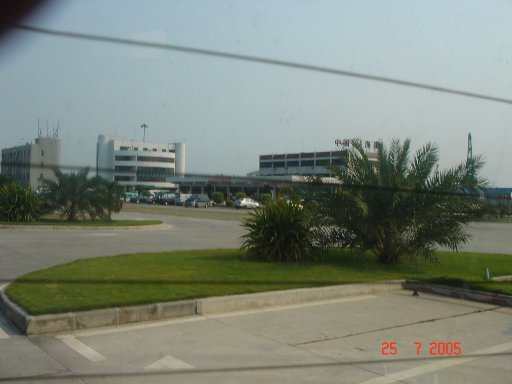
"JOHOR BAHARU, July 26 (Bernama) -- Syarikat LM Resources will set up a vehicle
assembly plant costing RM178 million at a 200-acre site in Bandar Penawar, Kota Tinggi.It will be the biggest vehicle assembly plant in Johor when operational from January 2007. The plant will assemble three models of vehicles from DADI Automobile Industry Ltd of China for the Malaysian market as well as those in Southeast Asia, West Asia, Europe and Africa.The three DADI models to be assembled initially at the plant are two sport utility vehicles called Shuttle and Tourer and a pick-up truck called Trekker."
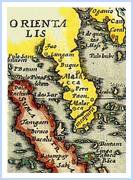
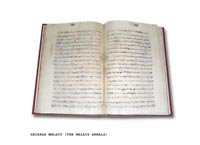
Sejarah Melayu(Malay Annals) is clearly the most famous, distinctive and best classical Malay prose to be ever produced, sharing in the great literary tradition other Malay works such as the Hikayat Hang Tuah, Hikayat Raja-Raja Pasai and the Hikayat Merong Mahawangsa. It chronicles the establishment of the Malaccan sultanate, charting a course of more than 600 years in a solid compact book filled with intricate details regarding royal protocol, royal lineages, weaving in various historical, mythical and legendary figures and episodes in a compendium that still captivates its audiences three centuries later.
The Sejarah Melayu or Malay Annals are unique in that they constitute the only available account of the history of the Malay Sultanate in the fifteenth and early sixteenth century. They are in the nature of what may be termed as historical literature conveying a historical narration on the origins, evolution and demise of a great Malay maritime empire, with its unique system of government, administration and politics. The Annals have universal appeal as they relate to a major transformation in the lives of the people of the Malay Archipelago from a Hindu-Malay matrix to an Islamic – Malay culture. Being an entrepot port, Melaka made rapid progress on account of its cosmopolitan population comprising merchants from India, China, Arabia, Portugal and various other nations of the world. They contributed to the social, economic and political evolution of the Malay Kingdom.
The main theme of this work was to laud the greatness and superiority of the Malaccan state, which had been founded about 1400. Although the Sejarah Melayu mentions only one date, events described in it can be verified by other historical sources. The Sejarah Melayu consists of a collection of stories, not historically connected, focusing on the activities of the Malaccan sultans, their courts, and government officials. In addition, foreign rulers were also described, as were Malacca's foreign relations and its importance as a regional trading centre. A noteworthy omission was the absence of any mention of peasant life. The Sejarah Melayu is significant for its well-written narrative and characterization of personalities, and it is also an important historical source about Malacca and the Malay world prior to Malacca's defeat by the Portuguese in 1511.
Attributed to Tun Seri Lanang as its first editor, the work was commissioned by Sultan 'Ala'u-d-din Ri'ayat Shah of Johor. It was claimed to have been begun in on Sunday May 13, 1612, in Pasai, Sumatra, where the Sultan was being held captive Mahkota Alam of Acheh. However, some scholars think that the original text was written prior to 1536 and underwent changes in 1612.
The main aim of this work was, undoubtedly, to laud the spleandour, greatness and superiority of the Melaka Sultanate - and it was written at a time when the Johor court, successors of the Melaka sultans, were being attacked by Portuguese and Achinese, their capital sacked many times and having to be moved from one part of the Straits to another. The court was frequently on the run from marauding invaders, their territories being overrun. The Sejarah Melayu was probably an attempt by the Johor court to overcome its sense of lost fortunes by regaining the past glories of a mythical golden age that was less than a generation past. It still serves to inspire the Malay of today - and to remind them of the heights that they can be, and have been, capable of reaching.

 les Gute zum Geburtstag!




 http://everything2.org/index.pl?node_id=1103828
Over the years, there has been considerable debate about who actually was the first man to sail around the world. We were all taught this historic honour belongs to Ferdinand Magellan (Fernao de Magalhaes, in his native Portuguese)who led the expedition of five ships and over 270 men out of Spain in 1519 and sailed westwards, reaching the Philippines, where he was killed. However, Magellan was thought to have travelled to as far as Sabah before, and one can argue that he had indeed actually completed circumnavigating the globe. Thereare also those who argue that the accolade should rightly belong to Sebastian del Cano, a mutineer from Magellan's crew, who led the one surviving ship, Victoria, and 17 other men, and limped back to Spain on September 8, 1522.
However, only one individual can truly claim to have been the first man to leave his home, sail around the globe and arrive at a part of the world where his mother tongue was spoken. That man was a Malay, Magellan's able servant and interpreter, called Enrique of Melaka or Henry the Black.
If there is any single Malay ever who has had the greatest impact on world history, it would probably be Enrique and we know so little of the man. He is called Panglima Awang in Malay literature but there is no mention of him in any credible Malay historical records. There is brief mention of Enrique in the official Spanish crew lists, as well as Magellan's last will and testament. Almost all of the certain facts that we know of Enrique come from the most comprehensive chronicle of Magellan's voyage, the narrative by Antonio Pigafetta, an Italian volunteer who joined Magellan's crew.
Pigafetta does briefly mention Enrique's origins - he was a Malay who had lived in Melaka but was originally from 'Zamatra' (Sumatra). Magellan was among the crew of the Portuguesesquadron of five ships under Diego Lopez de Sequeira which sailed into Melaka on September 1, 1509, and became the first Europeans to have contact with the Malay Peninsula. Magellan also took part in the capture of the city by the Portuguese in 1511 and it was probably then that he acquired a Malay slave, whom he gave the name Enrique.
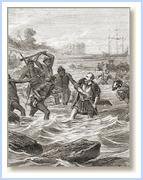
Photo:The Death of Magellan, from
a 19th century illustrationThe young Enrique may have been about 18 at the time - Magellan's will and testament made eight years later cited Enrique as being "of the age of twenty-six years, more or less". The will also stated specifically that Enrique was a "captured slave" - indicating that Enrique was not bought in a slave market by Magellan. There were thousands of slaves in Melaka belonging to the merchants and Malay nobility, and Portuguese records indicate that Sultan Mahmud of Melaka alone had over three thousand 'hambarages' ('Hamba Raja' or royal slaves). Many were in fact prisoners of war brought back from Melaka's successful campaigns against the kingdoms of Sumatra, Enrique's birthplace.
Enrique must be a guide and interpreter when Magellan travelled to different parts of the East Indies after Melaka's capture, reaching as far as Sabah. He then sailed back to Lisbon in 1512, with his loyal Malay servant in tow, and was dispatched to the Portuguese campaigns against the Moors in Morocco. Magellan was later accused of corruption left the service of the King of Portugal and offered his services to King Charles I of Spain in 1517. Magellan presented the King of Spain with his plan - to find a route sailing westwards to the Spice Islands, avoiding the Portuguese. It is said that he even had Enrique presented to the King to convince that he a man with the local language, knowledge and experience will make the voyage a success.
Magellan later declare in his will and testament that, upon his death, Enrique “shall be free and manumitted, and quit, exempt, and relieved of every obligation and subjection, that he may act as he desires and thinks fit.” Magellan even left Enrique a comfortable share from his estate, “the sum of ten thousand maravedis in money for his support”
The Spanish king agreed and Magellan was provided with five sailing ships - San Antonio, Conception, Victoria, Santiago and his flagship Trinidad -
and crews comprising over 270 men. They left the Spanish port of Sanlucar de Barrameda on September 20th, 1519 and began the daring and historic voyage of exploration ever - a voyage equaled to Man's landing on the moon 450 years later.
Across the Atlantic, down South America and across the Pacific, they sailed and finally, on March 16th , 1521 they sighted Samar, the most easterly of the Philippine islands. But on March 28th, a momentous event occurred. Pigafetta wrote: “.... we saw approaching two long boats, which they called Ballanghai, full of men, and in the larger was their king seated below an awning made of mats. And when they came near the captain's ship, the said slave (Enrique) spoke to that king, who understood him well.”
As they continued their voyage to the surrounding island kingdoms, it was Enrique alone who, on behalf of Magellan and the Spanish crown, spoke with kings and traders. Magellan had befriended the ruler of Cebu, Raja Humabon and was asked to punish rebellious natives in Mactan, under a warrior named Lapu Lapu. On Saturday, the 27th of April, Magellan attacked LapuLapu's with 60 men-at-arms - cannon, muskets, crossbows and steel swords against bamboo spears and poison-tipped arrows. But the small Spaniard force suddenly found itself overwhelmed by over 1,500 of Lapu Lapu's warriors.
Pigafetta noted that Lapu Lapu's men were converging their attacks on the Spanish captain himself - Magellan was first struck in the right leg by an arrow and later a spear stabbed him in the arm. For some reason, his cannon had now stopped firing and, despite being pressed by attacks for nearly an hour, no reinforcements had arrived from his waiting ships. Wading knee-deep in the surf, he was finally pierced by a spear in the right leg and he collapsed face down dead.
Enrique himself was wounded in the battle. Pigafetta writes that “he no longer went ashore to do necessary business but was always wrapped in a blanket” A new commander replace Magellan - a Portuguese by the name of Duarte Barbosa. Shouting at Enrique, Barbosa told him that although his master was dead, he was not to be freed but was to remain a slave.Pigafetta writes that Enrique went ashore and told Humabon that the Spaniards were about to depart immediately “but, if he would follow his advice, he would gain all their ships merchandise ... and so they plotted a conspiracy.”
The next day, Enrique told the Spaniards that Humabon had prepared jewels and presents asked them to come ashore to receive these. A party of Spaniards led by Barbosa did come, accompanied as usual by Enrique, but they were attacked. A lone survivor fled back towards the ships and, when asked if there were any others who survived the attack, he said all were dead, except the interpreter, Enrique.
Official Spanish records list Enrique of Melaka as one of the 27 men massacred in that attack, so we really do not know if Enrique did survive that attack, as Pigafetta claims. What we do know is that was the last we hear of Enrique in Pigafetta's diary - and he disappears into the mists of history. If Enrique had indeed made his way home from Cebu he would be the first man ever to have sailed around the world, rather than Magellan or del Cano.
One could also argue that the Spaniards may have indeed changed the official crew lists to ensure that this was not a possibility - how could a Malay slave have beaten the flower of Spanish manhood in the race around the globe? Certainly, Enrique was to be just a footnote to the heroic deeds of Magellan and del Cano that were told in countless books about this remarkable voyage written over the next few hundred years. Little was known about him even in Malaya until, in 1958, the writer Harun Aminurrashid published one of the greatest historical novels in modern Malay fiction, "Panglima Awang".
Despite Pigafetta's quite clear statement that he was from Sumatra, Filipino writers and historians are now claiming Enrique as one of their own countrymen. The most convenient feature of these theories is that if Enrique was indeed from Cebu, that would without any doubt make a Filipino the first man to have sailed around the world.
The main argument behind these theories is that Enrique could speak in the language of the people inhabiting the islands around Cebu - Bisayan - and therefore must have been from Cebu himself. There is a fatal flaw in this argument - Pigafetta's narrative above does show that Enrique could not communicate at all with the natives in his first encounter with them. It was only when he spoke with royalty - in this case, their king - or with traders that they suddenly found a common language among them. This is certainly not surprising - Malay was, by then, the 'lingua franca' of the whole Archipelago, and the official language of international diplomacy and trade for the whole region. All references to Enrique in Pigafetta's chronicle have him speaking with kings, chiefs or traders - rather than the common folk who may not have known the international language of Malay.
Enrique of Melaka had sailed the seas of the East Indies with his master; followed him across the Indian Ocean and around the rim of the African continent; loyally fought alongside him in North Africa; lived in the splendour of the royal courts of Portugal and Spain. He embarked upon the greatest adventure ever - to circle the globe, the final frontier; to explore strange new worlds; to seek out new life and new civilizations; to boldly go where no man has gone before.Having done that, he had returned full circle, to a land where he could understand the people and they could understand him. And there is just still the possibility that this humble Malay slave was indeed the first human ever to have sailed around the world.



You and I, fellow Collegian, are part of the ‘Malay College Mafia’ that’s being whispered about these days. Indeed, the Malay College Old Boys’ Association has become the nearest thing to a masonic lodge this country’s ever known outside the Chinese clans. MCOBA is a code with special access into every corner of governance in Malaysia: the government, the civil service, the private sector, academia, the palaces, everywhere. Old Boys of the Malay College can be found among the country’s foremost politicians, administrators and businessmen, bankers, doctors, lawyers and engineers. It remains the school of royalty. Not because the sons of the Sultans still study there – they do not, for valid enough reasons – but because their fathers once did.
The Malay College stands tall in the national conscience – even, perhaps especially, among those who never went there. Abdul Kadir bin Jasin, Group Editor of the New Straits Times, recently wrote about his feeling of inferiority at not having attended
one of the nations’ top residential schools: you’re not so eager to tell people where you went to school. But even a char koay teow seller is elevated by being an alumnus of the Malay College. (Yes, it remains possible to be an MC Old Boy and never know wealth or position. We are not all as rich and powerful as the richest and most powerful of us are. But the qualities remain the same. Diamonds in the dust sparkle just as brightly as those on a crown. Or a Rolex.)Why? Simple: Because MC was a good school, enrolling the best of Malay youth, having them live and compete with each other as equals, giving them good teachers and splendid playing fields. But let’s see what this means.Let’s attempt a definition:The Malay College is the most important school in
Malaysia, because it’s the most important school for the Malays. Unconscionable arrogance? Of course. It is a grotesque overstatement of the point: the greatest strength of the Malay College is that it teaches pride. And pride is the one thing the Malays have been striving throughout history.The NEP is about nothing else. It is simply today’s stage of the process that began
with Onn Jaafar cycling through the hinterland in 1946: the crusade to lift the
Malays out of their humble, dispirited, apathetic inertia and ensconce them on a
plane of dignity in their own country – a country that they had never been able
to save from foreign conquerors. The Portuguese, the Dutch, the British, the
Japanese, the British again... oh those damned British ! ...And now the Chinese,
whom too many Malays remain wary of regarding as fellow countrymen. Today’s Malay political ethic – and this feverish battle for dominance- stems from there having nothing but humiliation in the past five hundred years of Malay history.And what was Parameswara himself but a fleeing refugee from Temasik.
The Malays of Malaysia have no heroes to compare with the national deities of
Indonesia, for example. (Indeed, for the example that matters most.) We have no
Iskandar Thani, no Cut Nyak Dien or Singgamarajah. No Hatta or Sukarno or
Kartini. No martyrdom ever bloodied our soil, no valour stood triumphant in war.
Why else this endless fuss about Hang Tuah and Jebat, a pair of melancholy
poseurs with long libidos and short tempers?The Malay concept of heroism is fatally flawed in this one regard: it celebrates the defenders of the throne, exalting loyalty, and not the focus of the loyalty: the throne itself.
History reserves heroism for conquerors, regardless of whether they are
brutal or enlightened. But the various Malay States were never united under one
emperor king; on the contrary, they were fromed in the dissolution of the
biggest single Malay state in our past – Malacca – and spent their subsequent
sovereignties squabbling. What we long to remember as the Golden Age of the
Malays was in fact a drawn – out decline. We were never conquerors, only the
conquered, and that galls many Malays today. Hence this political obsession with the need to be vigilant against losing everything to the Outlanders. Ensuring
Malay pre-eminence – cultural, linguistic and parliamentary – is the central theme of Malay politics. It is really the fear of Malay eclipse; hence the durability of Hang Tuah’s famous utterance about the Malays never vanishing from the world.
The Malays’ greatest weakness is their sense of weakness. The aggressiveness now associated with Malay leadership stems from an ingrained inferiority complex. ("You don’t know what it’s like," Dr. Mahathir once told me in a recorded interview, "to be considered on par with dogs and other animals.")This is not a common weakness, however, among those who went to Malay College.The Malay College was singularly effective in curing its students of their sense of inferiority. Since its earliest years, the school has brought together young Malay men from every state, rich and poor, aristocrats and commoners, and educated them to the highest standards expected of them. In the process, three important truths were revealed to every boy who went to Kuala Kangsar on his first journey away from home and family:
First, intelligence had nothing to do with birth or breeding.
Second, there was indeed a unity of Malay states.
Third, education was synonymous with leadership;
there could not be one without the other, if either was to be done right.In teaching them to respect quality, ability and excellence (and having it proven year after year in examination halls and on playing fields alike), the Malay College raised its boys to see themselves as equal of their country’s greatest conquerors. The English-ness of the Malay College – all that Eton-of-the-East business – reached
its height in the Forties and Fifties, when the Fives Court was actually in use. Old Boys of that vintage must look back at their youth with a mixture of fond nostalgia tinged with a little embarrassment at those very pukka times. (In William Shaw’s biography of Tun Razak, there is a 1948 photo of Tun and a few friends in London. In stylish tweed suits they elegantly pose in St. James Park, each of them holding a pipe in the style Sherlock Holmes made famous.) But the Anglicisation was never quite as complete as it may have seemed to passers-by on Station Road or the Strand. For one thing, these were intelligent and well-educated young men, living in the heart of Empire during a time of great global change and intellectual energy. Giants walked the earth: the Churchills, Roosevelts and MacArthurs of the West giving ground to the Gandhis, Nehrus, Sukarnos, Chou En Lais and Ho Chi Minhs of Asia, as the British Empire,blown to smithereens by the Second World War, crumbled before the rising tide of history. To be young, bright and Malayan in London at such a time must have been to feel part of a great rebirth: to be the fledgling leaders of a new world of many nations where once there were only the empires of a few.And there
was something else, too, that served to continually remind these young, elite and English-educated mean of their Malayness. "You felt like a fool at their parties," says one who remembers, "standing around with your orange juice while they were all drinking gin and tonics and talking to themselves."What was irritating about this was not the inability to do everything the British way, but the perception that the British would always look down on those who did not. This irritation has persisted, because the British are notoriously slow to relinquish their historical pride, and we are notoriously slow to acquire ours. I believe this explains Dr. Mahathir’s remarkable campaign to settle scores with the British the moment he became Prime Minister. The Carrington snub, the Buy-British-Last policy, and the final triumph of his first official visit to Britain in 1987: the attention of Mrs. Thatcher and instant tickets to a West End musical with a six-month-long waiting list. Ironically, those Malays of Mahathir’s generation who received a British education are less impressed by Britain’s standards. Those educated at the Malay College began meeting those standards at the ages of ten or twelve.
When you know you are the equal of your conqueror, he is your conqueror no longer. He may be big, you may be small, but you both know your minds are equal. So you set aside the machinery of conquest, tell your bodyguards to wait outside and keep the peace, and start using your brains. You talk, negotiate, deal for what you both want. When your negotiations are successful, you know you have moved beyond barbarism. You are civilised men. The architects of Malayan Independence were conquerors too. But their weapons, with which they regained a country that had been lost to us for 450 years, were ideas. Not the Tamingsari, the kris of Hang Tuah, that ubiquitous symbol of Malay power; which as recently as October 1987 was still being proclaimed thirsty for Chinese blood. There were Malays among those men of Independence, as there were in the highest echelons of the first national administration of Malaya. Many of them were Old Boys of the Malay College. But because MC was founded to create an administrative elite, and because that ethic predated the emergence of politics in this country, relatively few
Old Boys have become politicians. The persistent need for ‘grassroots’ support
is partly to blame – College boys have long tended to leave their kampungs
behind once they’ve been through Prep School. Also, I feel, Old Boys are
inherently uncomfortable with the premise that political power is the only
defence against the Chinese because they’re shrewder, smarter, harder-working
and generally better than the Malays at everything else. College boys tend to
consider themselves capable of being as shrewd, smart and successful as anyone.
They’ve been taught to believe they can do anything as well as anyone and God
knows better than most.Those who regard the Malay College as a self-important bastion of neo-colonialism despise us for this. They see the Malay College as having done nothing but turn out generations of smug Anglophilic Melayus sneering at their peasant ancestors, while the foreigners were freely looting their lands. Malay College boys may have thought they were the leading edge of their people, but in fact they were leaving their people entirely behind. It is not an invalid view. But I prefer to regard those cocky brown men with their clubby English accents, proudly wearing their little white wigs at the Inns of Court, as having learned how to negotiate the return of a purloined booty. The crowning moment of that skill was, and remains, Merdeka Day 1957. But fundamental to Independence was the success of the UMNO-MCA-MIC Alliance. Independence could not have been won without the political linkage of the Malays, Chinese and Indians of Malaya. Negotiating that
linkage could only have done by the top men if each community, those versed in a
common voice. Speaking on behalf of the Malays, ensuring their primacy in the
Alliance and laying down so strong a defence that Malay political pre-eminence is today unchallenged, were many Old Boys of the Malay College. One of them, Abdul Razak bin Hussein, will be remembered as Malaysia’s first truly significant Prime Minister. Tunku Abdul Rahman, Bapa Malaysia, was an appointed representative. He was so full of happy linkages. A royal prince chosen by his people, fond of the Chinese and Indians and accepted as the best possible interface between them all. Tunku was legendary for being the most Anglophile Malay of his time – a dilettante aristocrat with a fondness for sports cars, horses and English university towns in autumn.Tunku’s premiership was as the Chief Malayan Witness to the end of Empire. He was a sweet, gentle and hopeful way to say goodbye to the old order. It was left to Tun Razak, Bapa Pembangunan, to design the blueprint for the new.
And how’s this for iron: The NEP, designed to elevate the Malays, was responsible for the rapid decline of the Malay College, which had done so much to make the NEP possible. In an astonishing display of wrong-headedness, the qualities of the Malay College were deemed detrimental to Malay pride.I was still at the College in the early Seventies, when the Education Minister at the time, Musa Hitam, declared "elitism is out". (The statement was made in Hargreaves Hall, during that year’s Speech Day. Musa had prefaced it however, with the statement that he had always wanted to attend Malay College, but had to settle for Johore’s English College instead.)"Elitism", in the sense Musa intended, referred to the grooming of a few selected Malays to stations above the mass of their people. This was apparently unjust. The Malay College had to be no different from other schools. Had that signified an intention to raise all schools to Malay College standards, it would have been laudable (if a bit far-fetched). But the most important thing was uniformity, "equal opportunities," and if other schools could not be raised to the stature of MC, MC would be lowered to the level of other schools. And then Headmasters began coming and going every couple of years, and the turnover of teachers trebled. Times changed very rapidly. Today the College no longer has a Sixth Form, (for reasons brilliantly perceived in a prescient essay by Ramli Mohammad in the College Magazine, Vol. VII No.3, 1973.) Standards declined precipitously. Because they were doing so across the board in Malaysian education, which was struggling to accommodate the new expectations of the NEP, the College retained its reputation as one of the best schools in the country. But that was relative to other schools, and not to the standards the College had traditionally set itself. Now, after nearly twenty years and the active involvement of MCOBA, the decline has been arrested.
We now hear the Sultan of Kedah call for the formal recognition of the College as a leading institution. An adulatory story on the College appears in the ‘Tatler’, of all places. And the ‘Malay College Mafia’ is now perceived as increasingly influential at all levels of Maalysia’s government and economy. ‘Elitism’, it would appear, is back with a vengeance. But then it had never gone away. What was once decried as ‘elitism’ the elevation of some above others – is now recognised as the process by which leaders emerge. As long as a nation needs leaders there will be a need for schools in which good minds are encouraged to reach for glory, recognising no limits to their potential other than those imposed by decency, discipline and compassion for the less favoured.
The Malay College has traditionally turned out men with a sense of responsibility to things greater than themselves, which is perhaps another reason for MCOBA’s rosters being notably short on politicians. But not on managers (a category in which I include all good businessmen, administrators and successful people in general). Successful management requires copious measures of the qualities MC has been known to cultivate: a vision of the Big Picture, and understanding of hierarchies and networks, a keen sense of identity and much self-confidence.
Good management is impossible without such qualities, but the worst management emerges when those in authority know they are not there because of their professional competence. This is why there are pejorative overtones to the word ‘elitism’ – it can also mean elevation for reasons other than ability and merit.
Such positions are political, and those occupying them know that their tenures have little to do with how they do their jobs. This is a fearful state to be in, and doing their jobs becomes secondary to serving the connections that are keeping them there.
I see this as part of the reason for the mediocrity that has come to afflict so many Malay ventures in both the public and private sectors. Success can only be measured in merit. That is as true in management as it is in the classroom, exam hall or on the running track – or Benches of Parliament.The NEP may be a step towards leveling the playing field for a true meritocracy to emerge in Malaysia, at which time the Malays can be said to have ‘arrived’. But while anxious gazes are fixed on the future, many seem to have forgotten that the Malay College has been a meritocracy since its inception. Thanks in part to schools like MC, the Malays are not entirely alien to success honestly earned and well deserved. Out of that comes pride, and out of that pride comes the confidence the Malays need if they are to negotiate constructively with their fellow countrymen –
especially those their politicians claim to distrust and fear. Much of that fear is cynically inflated for the sake of ‘Malay unity’, but it is nonetheless rooted in that damnable inferiority complex. That fear, while doing obviously nothing for Malay unity, has earned us the scorn of the non-Malays. But when the Chinese in particular realise that the Malays have begun losing their fear of being economically stripped, and are instead ready and able to deal intelligently with their partners as equals, there will be a burgeoning of opportunities to do so.This allows me to end this discourse on an optimistic note, for I believe the process is well underway. We can be certain that in boardrooms and corner office suites across the region, exemplary Malay executives, intellectuals and professionals are doing the talking on behalf of their people, thinking well, speaking intelligently and looking good; making the Malays look good and winning the confidence and respect of their
partners.We can also be sure that some of them are known to wear a certain striped tie on Wednesdays, deriving from that one item of apparel all the evidence they need of their capacity for success.
It would be nice to hope there are some politicians in them.

Description
In 1950 a new flag was introduced: the basic design is that preserved in the modern flag, but 11 stripes and an 11-pointed star, representing the number of constituent states. In 1963 three more states (Sabah, Sarawak, and Singapore)joined the federation and country's name changed to Malaysia. The common explanation for the addition of the 's' in the name is that all three new states start with this letter. The number of stripes on the flag was increased to 14 as was the numbers of points on the star.The flag of Malaysia is a combination of traditional Islamic symbols and the Stars and Stripes. The 14 stripes and the 14 points of the star represents the 14 member states and the crescent and star represents the dominant religion Islam. The blue canton stands for affiliation to the Commonwealth. The dimension of the flag is 1:2.
Jan Oskar Engene, 24 June 1996The old Malayan (for the Federation of Malaya) flag was similar to the present day Malaysian flag except that the star and the stripes were 11 for the 11 states of Peninsular (or West) Malaysia. The flag was changed with the creation of Malaysia in 1963.
Thomas W. Koh, 14 May 1997History of the Flag
The flag was chosen by a body established in 1949 to choose a flag for the Federation of Malaya. A competition was held by the Federal Legislative Assembly, in which 373 entries were submitted of which 3 made it to the final stage. The first design was a badge of crossed kris circled with 11 five-pointed stars. The second design was similar to the first, except that the 11 stars were arranged in two circles around the crossed kris. The third design was 11 blue and white stripes with a yellow moon and star at the hoist.The Malay Mail surveyed public opinion, and on 28/11/49 published the result, i.e. a majority for the third design, the creation of a government architect from Johore, En. Mohd b. Hamzah. With a few amendments the flag attained the support of the Council of Rulers on 22/2/50 and on 19/4/50 the Federal LegCo passed a motion That in the opinion of this Council the Flag of the Federation of Malaya should be as follows:- Eleven horizontal stripes alternately red and white in colour, the uppermost stripe being red, having a blue quarter with a crescent and eleven-pointed star in yellow superimposed, the standard size of the flag to be six feet by three feet.
The design was approved by HM King George VI on 19/5/50, and the flag was first flown at a flag-raising ceremony held by the British High Commisisoner on 26/5/50 in the compound of the Sultan of Selangor's palace, attended by TH the Rulers of the Malay States and British officials.
Andrew Yong, 15 August 1999
sourse http://www.crwflags.com/fotw/flags/my1950.html

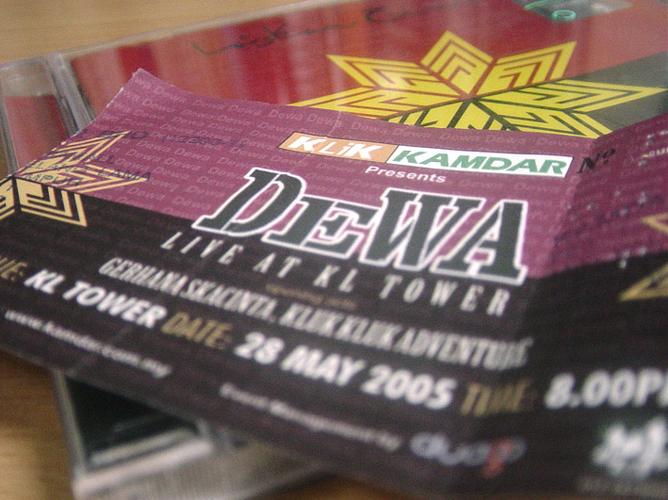 was pandemonium at KL Tower in the heart of the capital last Saturday when more than 6,000 fans crammed into the crowd space right underneath the tower to watch Indonesia’s Dewa live in concert. I thought my Mrs and myself could be the oldest couple in the crowd. Good to see that we have a few other senior fans as well.
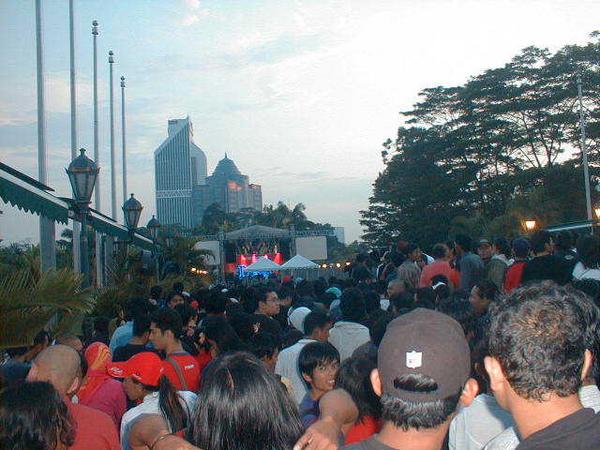 wned for trailblazing music, outspoken politics and the occasional brush with controversy. In Malaysia, Dewa’s adulating devotees (or baladewa, the band’s official term of endearmenr for its fans) have come to rival any in the region, with the popularity and impact of their most recent albums winning over lifelong Malaysian fans.
 e catalyst and ringleader in concert as he alternated between singing lead vocals, enthralling the audience on his favoured keyboards and keeping time on the acoustic guitar. Along with Once and mysterious lead guitarist Andra Ramadhan (who was Dewa’s Joe Perry to Once’s Steven Tyler onstage), it was this triumvirate that kept the crowd transfixed throughout Saturday’s show. Anchored by bass player Yuke and drummer Tyo Nugros, the robust Dewa showed why it w
 as a band synonymous with sold-out concerts. One thing to note: The venue sucks... how could you put thousands of screaming fans on that small piece of shit in front of KL tower, and the stage is too damn low. Pity those cewek pendek who can't see the band.
Roman Picisan; Bintang
Lima ;
Ciptaan :Dhani
Tatap matamu bagai busur panah
Yang kau lepaskan ke jantung hatiku
Meski kau simpan cintamu masih
Tetap nafasku wangi hiasi suasana
Saat kau kecup manis bibirmu
Cintaku tak harus,miliki dirimu
Meski perih mengiris-iris segala janji
Aku berdansa diujung gelisah
Di iringi syahdu lembut lakumu
Kau sebar benih anggun jiwamu
Namun kau tiada...menuai buah cintaku
Yang ada hanya sekuntum rindu


"Victory" on the rampage
No one was more surprised, I am sure, than the DAP and the newly-formed Gerakan with their unexpected successes. They felt not only cocky, but downright arrogant. They lost no time in arranging to celebrate their "victories." Dr. Tan Chee Khoon, who won his seat in Batu Selangor, with a big majority asked for Police permission to hold a procession by members of his Gerakan Party. A permit was granted on condition that it followed a route authorised by the Police. (On 12th May) Dr. Tan's victory procession was held on an unprecedented scale, politically speaking, and was accompanied by acts of rowdyism and hooliganism and in utter defiance of the Police after the main procession had ended.The procession went through unauthorised routes, jamming traffic everywhere as a consequence. With victory emotions on the loose and - there can be no other explanation - Communists urging them on, the victors made a serious blunder, and blunder it was. The procession shouting its way along turned into Jalan Campbell and Jalan Hale - roads on the edge of an leading into Kampong Bahru where 30,000 Malays have lived in peace for years beneath the palms in their own settlement in the centre of Kuala Lumpur.
Jalan Hale is the main street of Kampong Bahru. There they proceeded to provoke the Malays, gibing at them and throwing their victory in their faces in the midst of what is virtually an UMNO stronghold.On Tuesday, May 13th Gerakan Party's Yeoh Tech Chye, the President of the Malaysian Trades Union Congress (who won big in Bukit Bintang, Kuala Lumpur) made an open apology in the press for his party supporters having caused such inconvenience to the public. But the emotional damage had already been done.
I (Tunku) returned to Kuala Lumpur about lunchtime from Alor Star. My Principal Private Secretary informed me that he had received news that a counter demonstration was to be held on May 13th as the Malays were very annoyed.UMNO was going to stage a procession to celebrate it's victory and that a crowd would gather in the compound of the house of the Menteri Besar of Selangor, Dato Harun bin Idris, in Jalan Raja Muda and that the procession would start from there. I was personally worried that the procession might lead to trouble. It was not easy to stop it at this stage as the Opposition had already held processions, and permission had already been obtained for UMNO to have theirs.
May 13th
..…A phone call came through at 6.45pm that an ugly incident had taken place along Jalan Raja Muda in which some Chinese were assaulted. Immediately afterwards Enche Mansor, the Kuala Lumpur Police Traffic Chief, and one or two others, came to see me and said that there had been killing. The city had been placed under immediate curfew as at 7 pm.The Security Forces were out, the army called in. Naturally I could not sleep that night, my mind upset with the tragedy that had overtaken our peaceful capital and nation. I went out side my balcony outside my room looking down on the city in the valley by night. Flames were burning high in several areas, near Kampong Bharu and to the North. Kuala Lumpur was a city on fire and it was a sight that I never thought I would see in my lifetime.
While they were gathered in the compound of Dato Harun's residence news came through suddenly that Chinese had attacked Malays in Setapak, a mile or two to the North, as they were on their way to join the procession starting from Jalan Raja Muda. The news created a storm of indignation; hell broke loose. Two Chinese passing by on motor cycles were attacked and killed. And so the riots of May 13th began, triggering off violence unprecedented in the history of Malaysa. (A state of emergency was declared on May 16th and a National Operations Council set up to deal with all matters pertaining to it. The first act: round-the-clock curfew.)..Within 48 hours it was possible for the Council to approve relaxation in the curfew in many areas of the country. Even in the most sensitive ares, Kampong Bharu and the Jalan Chow Kit sections of Kuala Lumpur, where the violence had originated, it was possible after one week from the outbreak to announce curfew relaxations there.
There was no insecurity in the East Coast states. In Johore and Negri Sembilan no incidents had occurred at any time. In Malacca there had been a few minor troubles and they had now ceased as quickly as they had started. There were no incidents taking place in Perak and Penang, Kedah and Perlis.Apart from Kuala Lumpur, the only sections in the country needing the strictest vigilance were in the Betong salient, the rural areas along the Kedah and Perak borders with Thailand. The general situation, however, was far from normal, mainly for one particular reason - rumours. During the height of the disturbances rumour-mongering was wild and widespread as always happen anywhere in time of riot.
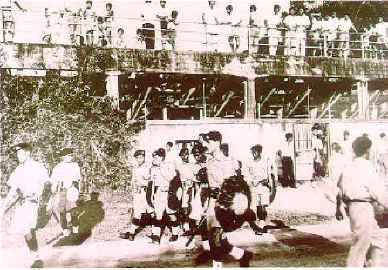 Foto:Anggota Pasukan Simpanan Persekutuan sedang mengawal rusuhan di stadium Jalan Raja Muda
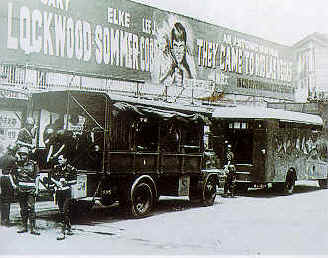 asa mengadakan perarakan di jalan-jalan raya di sekitar Kuala Lumpur.
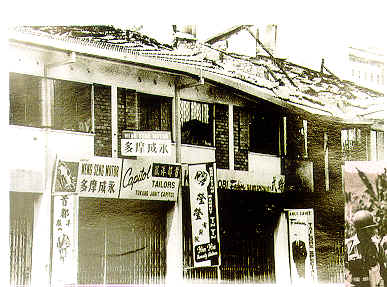 ntadbiran diambil-alih oleh Askar Melayu.
 Foto: Kalau tak silap ini foto Ahli Mageran termasuk Tun Hanif Omar (berdiri: 4 dari kiri) dan Dato Sri Abdullah Badawi (berdiri:1 dari kiri)