Wednesday, October 26, 2005

Nice radio?


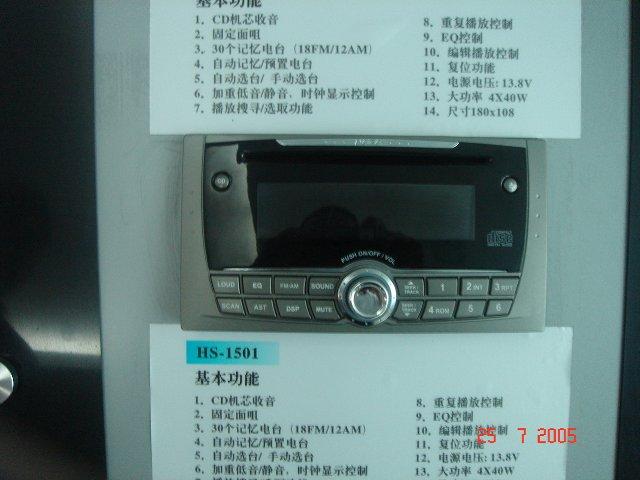
With all the AP hu hah in the last few weeks, I just remembered that while visiting an audio factory in Shenzen, China I saw something that is very familiar on the Naza dash board. The radio, specifically the radio CD set for the NAZA CITRA.

So its not really Korean component is it? So why China and not Malaysian made radios? The factory that we went to is the OEM (Original Equipment Supplier to the uninitiated) to at least 2-3 Chinese car companies ( and yes they have similar car companies like Malaysia, something like 1st National Car Company, 2nd National Car company , 3rd etc etc) , they alsa make for HYUNDAI and VW for local Chinese market. At the end of the day it is bottom line decicion. Get it as cheap as possible.

Tuesday, October 25, 2005

Al Fatihah


It has been 2 years since an old friend passed away on October 23, 2003. http://joe-blogs.blogspot.com/ Everytime I drive past the Kiara cemetery I remind myself to offer Al Fatihah to all Muslims. As always 'kesedaran' that one feels inside will not last long. Fortunately moments like that will always remind me that one day I will be gone too.

Monday, October 24, 2005

The Kenduri

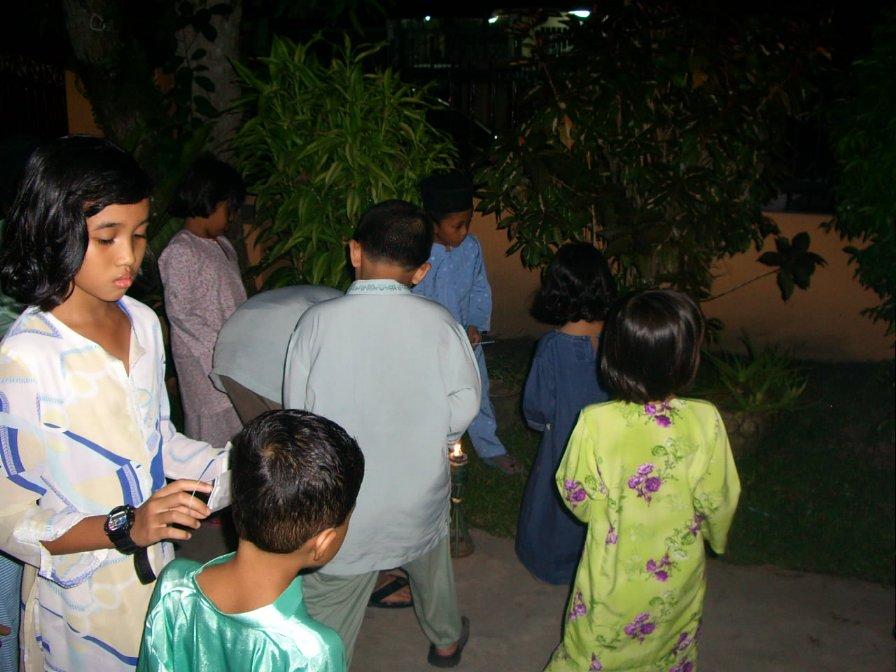
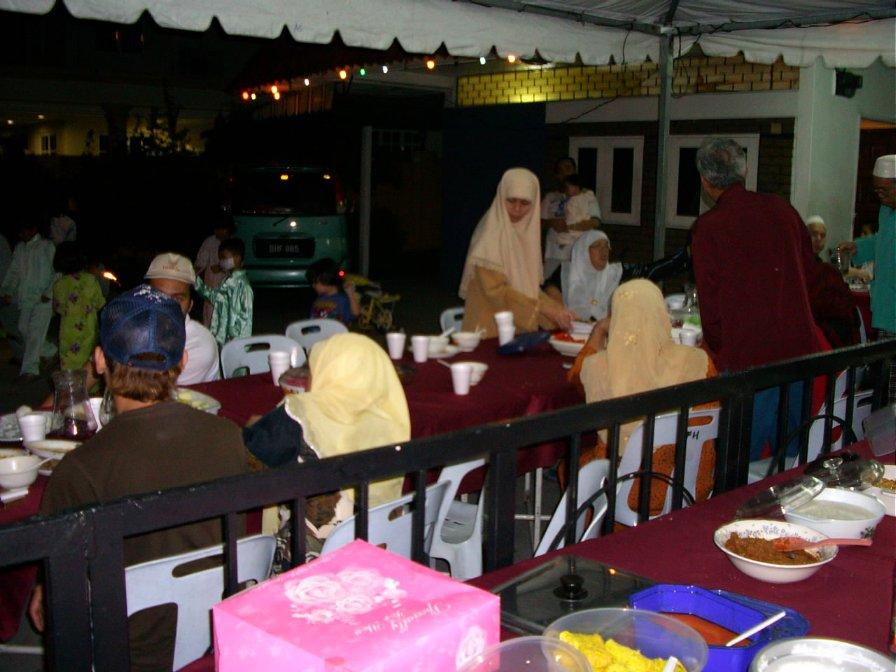
The kenduri on Malam 17 Ramadhan went well. I guess the lamb or is it kambing was not enough. The bulk of it went into the rendang, while the balance went into the soup. Semua taroh inside the soup. Just to ensure the food is enough for everyone we added 4 more chickens. Ayam bakar sampai hitam, surprisingly it went down well with the guest. Maybe the sight of coal fire under the marinated chicken pieces is too much a temptation. The kambing was in demand too. Even the pak imam yang berpantang kambing had a bowl full of sup kambing.

But it was the kids who really enjoyed themselves I guess. After the food they ran havoc all over the place. Add some fire crackers and mercun bodoh sikit then the compound became alive with laughter. My grandma still ask me the same questions again and again, she is in her mid 80's now will failing memory. That night alone she asked me twice within 2 minutes where do I live and how many kids I have. At least she can still walk and take care of herself. I wonder if I can do that when I reach her age.

Friday, October 07, 2005

You are 10 years old today


Happy Birthday to Aini, you are 10 years old today. This is Aini, our first joy born in 1995.

Monday, September 26, 2005


Nice HYUNDAI car ya? Posted by Picasa

Rear view of that Hyundai Posted by Picasa

Look out for the NEW Hyundai Elantra (is it? I think so) coming to our shores in 2006. It looks like a HONDA Accord but selling in Korea at around RM60k. DROOL
Posted by Picasa

Tuesday, September 13, 2005

The Real Malay by Sir Frank Swettenham (1850-1946), Colonial administrator


One of the architects of British Malaya, Frank Swettenham arrived in the Malay Peninsula in 1871 and, in subsequent years, became appointed the British Resident in Selangor and Perak, Resident General of the Federated Malay States and, finally, Governor of the Staraits Settlement and High Commissioner of the Malay States in 1901. This was in no small part due to his keen interest in the country and its people - he was known as one who lived with them, spoke their language and respected their faith, in spite of his own English prejudices.

The Real Malay by Sir Frank Swettenham
To begin to understand the Malay you must live in his country, speak his language, respect his faith, be interested in his interests, humour his prejudices, sympathise with and help him in trouble, and share his pleasures and possibly his risks. Only thus can you hope to win his confidence. Only through that confidence can you hope to understand the inner man, and this knowledge can therefore only come to those who have the opportunity and use it. So far the means of studying Malays in their own country (where alone they are seen in their true character) have fallen to few Europeans,, and a very small proportion of them have shown an inclination get into the, hearts of the people. There are a hundred thousand Malays in Perak and some more in other parts of the Peninsula; and the white man, whose interest in the race is strong enough, may not only win confidence but the devotion that is ready to give life itself in the cause of friendship. The Scripture says: “There is no greater thing than this”; and in the end of the nineteenth century that is a form of friendship all too rare. Fortunately this is a thing you cannot buy, but to gain it is worth some effort.

The real Malay is short, thick-set. well.-built man, with straight black hair, a dark. brown complexion, thick nose and lips, and bright intelligent eyes. His disposition is generally kindly, his manners are polite and easy. Never cringing, he is reserved with strangers and suspicious, though he does not show it. He is courageous and trustworthy in the discharge of an undertaking; but he is extravagant, fond of borrowing money. and very slow in repaying it. He is a good talker, speaks in parables, quotes proverbs and wise saws, has a strong sense of humour, and is very fond of a good joke. He takes an interest in the affairs of his neighbours and is consequently a gossip. He is a Muhammadan and a fatalist but he is also very superstitious. He never drinks intoxicants, he is rarely an opium-smoker. But he is fond of gambling,, cock-fighting,' and kindred sports. He is by nature a sportsman; catches and tames elephants; is a skilful fisherman, and thoroughly at home in a boat.

Above all things, he is conservative to a degree, is proud and fond of country and his people, venerates his ancient customs and traditions, fears his Rajas, and has a proper respect for constituted authority - while he looks askance on all innovations, and will resist their sudden introduction. But if he has time to examine them carefully, and they are not thrust upon him, he is willing to be convinced of their advantage. At the same time he is a good imitative learner, and, when he has energy and ambition enough for the task, makes a good mechanic. He is however lazy to a degree, is without method or order of any kind. knows no regularity even in the hours of his meals, and considers time
as of no importance.

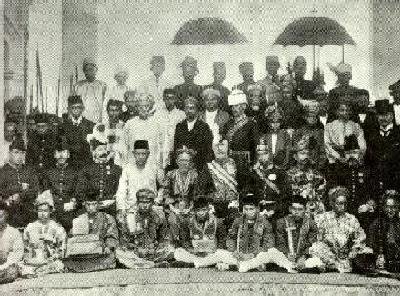
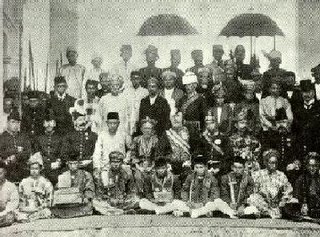
Photo:The first ever meeting of the Conference of Rulers,held in Kuala Kangsar in 1897

His house is untidy, even dirty but he bathes twice a day, and is very fond of personal adornment in the shape of smart clothes.

A Malay is intolerant of insult or slight; it is something that to him should be wiped out in blood. He will brood over a real or fancied stain on his honour until he is possessed by the desire for revenge. If he cannot wreak it on the offender, he will strike out at the first human being that comes in his way, male or female, old or young. It is this state of blind fury, this vision of blood, that produces the amok. The Malay has often be called treacherous. I question whether he deserves the reproach more then other men. He is courteous and expects courtesy in return, and he understands only one method of avenging personal insults.

The spirit of the clan is also strong in him. He acknowledges the necessity of carrying out, even blindly, the orders of his hereditary, chief, while he will protect his own relatives at all costs and make their quarrel his own.

The giving of gifts by Raja to subject or subject to ruler, is a custom now falling into desuetude, but it still prevails on the occasion of the accession of a Raja, the appointment of high officers, a. marriage, a circumcision ear-piercing or similar ceremony. As with other Eastern people, hospitality is to the Malay a sacred duty fulfilled by high and low, rich and poor alike.

Though the. Malay is an Islam by profession, and would suffer crucifixion sooner than deny his faith, he is not a bigot; indeed, his tolerance compares favourably with that of the professing Christian, and, when he thinks of these matters at all, he believes that the absence of hypocrisy is the beginning of religion. He has a sublime faith in God, the immortality of the soul, a heaven of ecstatic earthly
delights, and a hell of punishments, which every individual is so confident will
not be his own portion that the idea of its existence presents no terrors.Christian missionaries of all denominations have apparently abandoned the hope of his conversion.

In his youth, the Malay boy is often beautiful ... a thing of wonderful eyes, eyelashes, and eyebrows, with a far-away expression of sadness and solemnity, as though he had left some better place for a compulsory exile on earth.Those eyes, which are extraordinary large and clear, seem filled with a pained wonder at all they see here, and they give the impression of a constant effort to open ever wider and wider in search of something they never find. Unlike the child of Japan, this cherub never looks as if his nurse had forgotten to wipe his nose. He is treated with elaborate respect if he so desires, eats when he is hungry, has no toys, is never whipped, and hardly ever cries.Until he is fifteen or sixteen, this atmosphere of a better world remains about him. He is often studious even, and duly learns to read the Koran in a language he does not understand.

Then, well then,. from sixteen to twenty-five or later he is to be avoided. He takes his pleasure,. sows his wild oats like youths of a higher civilisation, is extravagant, open-handed, gambles, gets into debt, run away with his neighbour's wife and generally asserts himself. Then follows a period when he either adopts this path and pursues it, or, more commonly, he weans himself gradually from an indulgence that has not altogether realised his expectation, and if, under the advise of older men, he seeks and obtains a position of credit and usefulness in society from which he begins at last to earn some profit, he will from the age of forty, probably develop into an intelligent man of miserly and rather grasping habits with some one little pet indulgence of no very expensive kind.

The Malay girl-child is not usually so attractive in appearance as the boy, and less consideration is shown to her. She runs wild till the time comes for investing her in a garment, that is to say when she is about five years old. From then, she is taught to help in the house and kitchen, to sew, to read and write, perhaps to work in the padi field, but she is kept out of the way of all strange menkind. When fifteen or sixteen, she is often almost interesting; very shy, very fond of pretty clothes and ornaments, not uncommonly much fairer in complexion than the Malay man, with small hands and feet, a happy smiling face, good teeth, and wonderful eyes and eyebrows - the eyes of the little Malay boy. The Malay girl is proud of a wealth of straight, black hair, of a spotless olive complexion, of the arch of her brow - ;like a one-day-old moon" - of the curl of her eyelashes, and of the dimples in cheek or chin.

Unmarried girls are taught to avoid all men except those nearly related to them. Until marriage, it is considered unmaidenly for them to raise their eyes or take any part or interest in their surroundings when men are present. This leads to an affectation of modesty which, however over-strained, deceives nobody.

After marriage, a woman gets a considerable amount of freedom which she naturally values. In Perak a man, who tries to shut his womankind up and prevent their intercourse with others and a participation in the fetes and pleasures of Malay society, is looked upon as a jealous, ill-conditioned person. Malays are extremely particular about questions of rank and birth, especially when it comes to marriage, and mesalliances, as understood in the West, are with them very rare.

The general characteristics of Malay women, especially those of gentle birth, are powers of intelligent conversation, quickness in repartee, a strong sense of humour and an instant appreciation of the real meaning of those hidden sayings which are hardly even absent from their conversation. They are fond of reading such literature as their language offers, and they use uncommon words and expressions, the meanings of which are hardly known to men. For the telling of secrets, they have secret modes of speech not understanded of the people.

They are generally amiable in disposition, mildly - sometimes fiercely - jealous, often extravagant and, up to about the age of forty, evince increasing fondness for Jewellery and smart clothes. In these latter days they are developing a pretty taste for horses, carriages, and whatever conduces to luxury and display, though, in their houses, there are still a rugged simplicity and untidiness, absolutely devoid of all sense of order.

A Malay is allowed by law to have as many as four wives, to divorce them, and replace them. If he is well off and can afford so much luxury, he usually takes advantage of the power to marry more than one wife, to divorce and secure successors; but he seldom undertakes the responsibility of four wives at one time. The woman on her part can, and of ten does, obtain a divorce from her husband. Written conditions of marriage, "settlements" of a kind, are common with people in the upper classes, and the law provides for the custody of children, division of property, and so on. The ancient maiden lady is an unknown quantity, so is the Malay public woman; and, as there is no society bugbear, the people lead lives that are almost natural. There are no drunken husbands, no hobnail boots, and no screaming viragoes - because a word would get rid of them. All. forms of madness, mania, and brain-softening are extremely rare.

The Malay has ideas on the subject of marriage, ideas born of his infinite experience. He has even soared into regions of matrimonial philosophy, and returned with such crumbs of lore as never fall to the poor monogamist.I am not going to give away the secrets of the life behind the curtain; if I wished to do so I might trip over difficulties of expression; but in spite of the Malay's reputation for bloodthirstiness, in spite of (or because of, whichever you please) the fact that he is impregnated with the doctrines of Islam, in spite of his sensitive honour and his proneness to revenge, and in spite of his desire to keep his own women (when young and attractive) away from the prying eyes of other men, he yet holds this uncommon faith, that if he has set his affections on a woman, and for any reason he is unable at once to make her his own, he cares not to how many others she allies herself provided she becomes his before time has robbed her of her physical
attractions.His reason is this. He says (certainly not to a stranger, rarely even to his Malay friends, but to himself) "if, after all this experience, she like me best, I have no fear that she will wish to go further afield. All Malay girls marry before they are twenty, and the woman who has only known one husband, however attractive he may be, will come sooner or later to the conviction that life with another promises new and delightful experiences not found in the society of the first man to whom destiny and her relatives have chosen to unite her. Thus some fool persuades her that in his worship and passion she will find the World's Desire, and it is only after perhaps a long and varied experience that she realises that, having started for a voyage on the ocean, she finds herself seated at the bottom of a dry well'.

It is possible that thus she becomes acquainted with truth

source: http://www.sabrizain.demon.co.uk/malaya/malays2.htm
Wednesday, August 31, 2005

in MERDEKA mood...


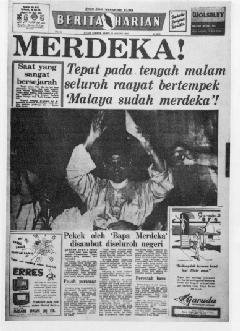
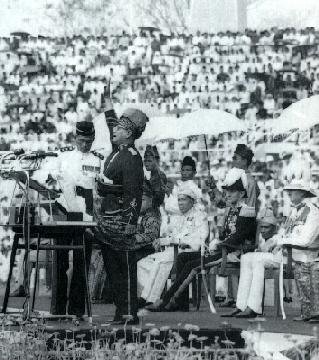
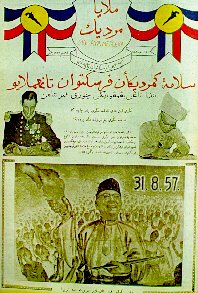
some photos from the past on MERDEKA

Tuesday, August 30, 2005

MCKK 100 years stamps


The Malay College, Kuala Kangsar (MCKK) is the premier and first fully-residential school in Malaysia. Established on 2nd January 1905, it was originally known as the Malay Residential School of Kuala Kangsar. It was an all Malay boys' school located in the Royal Town of Kuala Kangsar, Perak.

The school was the brainchild of Mr. R. J. Wilkinson, then Inspector of Schools for the Federated Malay States. In a letter to the Resident-General dated 2nd February 1904, he wrote about "establishing at a suitable locality in the FMS a special residential school for the education of Malays of good family and for the training of Malay boys for admission to certain branches of Government Service."

Its formation was enthusiastically supported by the then Ruler of the Federated Malay States, Sultan Idris Murshidul Adzam Shah of Perak, Sultan Alaiddin Sulaiman Shah of Selangor, YAM Tuan Tuanku Muhamad Shah of Negeri Sembilan and Sultan Ahmad Al-Mu'adzam Shah of Pahang.

Since its inception, more than 5,000 boys (and 2 girls) have had the privilege to enter the gates of The MCKK. Though it was initially founded to educate the Malay elites, it changed dramatically as a result of rising Malay nationalism since 1947. Today, selected Malay boys from all walks of life and aged from 12 to 17 from all over Malaysia are educated in the MCKK.

MCKK celebrated its Centennial Anniversary on 26th March 2005. Attended by Royalties, dignitaries, Old Boys and townspeople, The Malay College Kuala Kangsar was fondly referred to as the Eton of the East. It was declared a National Heritage by His Majesty the Yang DiPertuan Agong. His Majesty re-affirmed that the Malay Rulers "....shall remain as Royal Patrons of The Malay College Kuala Kangsar for as long as the sun, the moon and the star move across the Heavens."

The most recognisable, oldest and famous landmark of MCCK is none other than the imposing 2-storey building with pseudo-Greco-Roman architecture fronted by a vast playing field. It is known as the Big School. The official opening of the building took place on Saturday, 11th December 1909 and was officiated by Sultan Idris Murshidul 'Adzam Shah, Sultan of Perak. In 1955, the West and East Wings were added and together they make up what is now called the Big School. The Big School is currently the main hostel for the seniors. The Big School remains as a majestic edifice of The Malay College.

The establishment of MCKK was enthusiastically supported by the then Ruler of the Federated Malay States, Sultan Idris Murshidul Adzam Shah of Perak, Sultan Alaiddin Sulaiman Shah of Selangor, YAM Tuan Tuanku Muhamad Shah of Negeri Sembilan and Sultan Ahmad Al-Mu'adzam Shah of Pahang.As a mark of respect, honour and appreciation to these four Rulers, the four Houses were named after them, namely Idris (White), Sulaiman (Red), Muhamad Shah (Yellow) and Ahmad (Black).

Note COMBO FIRST DAY COVER with Malay College Kuala Kangsar Cancel!

Saturday, August 20, 2005

MCKK/MCOBA LOGOs...


nice logos. May MCKK live another 100 years to come so our children and grand children will be there to celebrate it in a more grandeur style.

I took the words below from the writing of an old boy, Raja Petra Kamarudin back in 2003;

Her Majesty the Queen of England once called MCKK “the Eaton of the East” when she visited Malaysia a couple of years ago. It is said His Highness the King of Malaysia then corrected her by calling Eaton “the MCKK of the West”. This, of course, cannot be confirmed but ask any “Old Boy” -- what an ex-Collegian is called though, let me assure you, none of these Old Boys act old -- and they would all agree that Eaton is what it is because they copied the traditions of MCKK.

The Battle of Britain was won on the playing fields of Eaton, they say. Well, Malaya’s independence was won on the playing fields of MCKK. As much as Malaysian Prime Minister Dr Mahathir Mohamad and UMNO try very hard to give the impression that Malaya’s independence was won due to UMNO’s struggle, what the history books fail to mention is that many of those “independence fighters” were products of MCKK. Granted it was a “peoples’ struggle”, but the rakyat, to quote Dr Mahathir, are like a herd. They just follow the leader, and it needed a leader to lead them to independence. And MCKK provided these leaders of independence.

I cannot resist mentioning that many of these early independence fighters like Sir Dato Onn bin Jaffar (Hussein Onn’s father), Dato Abdul Wahab (Dato Panglima Bukit Gantang and one time Menteri Besar of Perak), Dato Laksmana Razali, Tun Aziz bin Abdul Majid (one time Governor of Melaka), Dato Haji Kamaruddin bin Haji Idris (Dato Suhaimi’s father), Tun Abdul Razak (Dato Seri Najib’s father), Raja Sir Tun Uda (my grandfather), Dato Bahaman, Dato Andika Indera, and so on, were mostly old boys of the MCKK.

MCKK had become the seat of Malay nationalism. This was probably the biggest blunder the British ever made in Malaya. If R. J. Wilkinson was still around today, he would probably say, “Give the Malays education, old chap, and they start having VISIONS!”

Thursday, August 04, 2005

Another Car from China?


Here is another China make car err SUV that will enter Malaysia soon.

"JOHOR BAHARU, July 26 (Bernama) -- Syarikat LM Resources will set up a vehicle
assembly plant costing RM178 million at a 200-acre site in Bandar Penawar, Kota Tinggi.It will be the biggest vehicle assembly plant in Johor when operational from January 2007. The plant will assemble three models of vehicles from DADI Automobile Industry Ltd of China for the Malaysian market as well as those in Southeast Asia, West Asia, Europe and Africa.The three DADI models to be assembled initially at the plant are two sport utility vehicles called Shuttle and Tourer and a pick-up truck called Trekker."


Source Bernama http://www.bernama.com.my/bernama/v3/news_lite.php?id=147069

Sunday, July 31, 2005

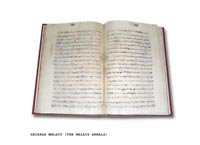
Sejarah Melayu (The Malay Annals)


I had a hard time in the last few months searching for The Sejarah Melayu or the Malay Annals. O Yes at last I found them in Dewan Bahasa bookshop.. the luxury version will cost me a bomb, what with leather bound et all, and the cheaper version are from the STPM series. Even then there are claims that the cheaper version may have differences in facts. So what is so special about the Sejarah Melayu?

Sejarah Melayu(Malay Annals) is clearly the most famous, distinctive and best classical Malay prose to be ever produced, sharing in the great literary tradition other Malay works such as the Hikayat Hang Tuah, Hikayat Raja-Raja Pasai and the Hikayat Merong Mahawangsa. It chronicles the establishment of the Malaccan sultanate, charting a course of more than 600 years in a solid compact book filled with intricate details regarding royal protocol, royal lineages, weaving in various historical, mythical and legendary figures and episodes in a compendium that still captivates its audiences three centuries later.

The Sejarah Melayu or Malay Annals are unique in that they constitute the only available account of the history of the Malay Sultanate in the fifteenth and early sixteenth century. They are in the nature of what may be termed as historical literature conveying a historical narration on the origins, evolution and demise of a great Malay maritime empire, with its unique system of government, administration and politics. The Annals have universal appeal as they relate to a major transformation in the lives of the people of the Malay Archipelago from a Hindu-Malay matrix to an Islamic – Malay culture. Being an entrepot port, Melaka made rapid progress on account of its cosmopolitan population comprising merchants from India, China, Arabia, Portugal and various other nations of the world. They contributed to the social, economic and political evolution of the Malay Kingdom.

The main theme of this work was to laud the greatness and superiority of the Malaccan state, which had been founded about 1400. Although the Sejarah Melayu mentions only one date, events described in it can be verified by other historical sources. The Sejarah Melayu consists of a collection of stories, not historically connected, focusing on the activities of the Malaccan sultans, their courts, and government officials. In addition, foreign rulers were also described, as were Malacca's foreign relations and its importance as a regional trading centre. A noteworthy omission was the absence of any mention of peasant life. The Sejarah Melayu is significant for its well-written narrative and characterization of personalities, and it is also an important historical source about Malacca and the Malay world prior to Malacca's defeat by the Portuguese in 1511.

Attributed to Tun Seri Lanang as its first editor, the work was commissioned by Sultan 'Ala'u-d-din Ri'ayat Shah of Johor. It was claimed to have been begun in on Sunday May 13, 1612, in Pasai, Sumatra, where the Sultan was being held captive Mahkota Alam of Acheh. However, some scholars think that the original text was written prior to 1536 and underwent changes in 1612.

The main aim of this work was, undoubtedly, to laud the spleandour, greatness and superiority of the Melaka Sultanate - and it was written at a time when the Johor court, successors of the Melaka sultans, were being attacked by Portuguese and Achinese, their capital sacked many times and having to be moved from one part of the Straits to another. The court was frequently on the run from marauding invaders, their territories being overrun. The Sejarah Melayu was probably an attempt by the Johor court to overcome its sense of lost fortunes by regaining the past glories of a mythical golden age that was less than a generation past. It still serves to inspire the Malay of today - and to remind them of the heights that they can be, and have been, capable of reaching.

source:
http://www.sabrizain.org/malaya/malays1.htm
http://www.britannica.com/eb/article-9066639

Saturday, July 30, 2005

From Seoul to Kota Kinabalu


stopped at KK on the way back to KL from Seoul

Final day in Seoul


The plane waiting to fly us back via Kota Kinabalu

The old and new Seoul railway station standing next to each other. Posted by Picasa

Friday, July 29, 2005

Happy Birthday To You


Birthday of my better half. Unfortunately this year I couldn't celebrate it with her as I was away in Seoul.

Photo: A restaurant in Goodview Hotel, Dong Guan ,China to remind me of her (beautiful hotel next to a lake)


German-Alles Gute zum Geburtstag!
Greek-Eytyxismena Genethlia! or Chronia Pola!
Gujarati -Janma Divas Mubarak!
Hawaiian-Hau`oli la hanau!

Is Happy Birthday Really Copyrighted?Yes.
The melody for Happy Birthday was first penned by two sisters from Kentucky, Mildred J. Hill and Patty Smith Hill. The song was called Good Morning to All, but bore the recognizable melody. The tune was first published in 1893 in the book Song Stories for the Kindergarten. The melody has since passed into the public domain, and is safe to hum in public without permission.
While it is not entirely clear who first wrote down the words for Happy Birthday, it showed up in a few places before Jessica Hill (another Hill sister) was able to demonstrate undeniable similarities between Good Morning to All and Happy Birthday and to secure the copyright to the song

to NAMDAEMUN


our trip to the NAMDAEMUN (I believe it means South Gate, old gateway to Seoul) with Mr Park Jr and Mr Park Sr, and the famous Namdaemun Market, mak cik makcik from Malaysia will go crazy over the brooches, 1 big building selling brooches

Tuesday, July 26, 2005

Zhaoqing, Guangdong


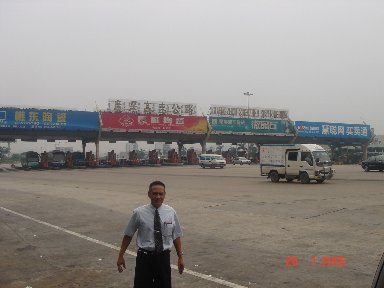
from Shenzen it was 3 hours by road to Zhaoqing.

Foto: 1,2. Hope Fortune Ltd factory, 3.toll plaza from Shanzen to Zaoqing

Monday, July 25, 2005

Shenzen


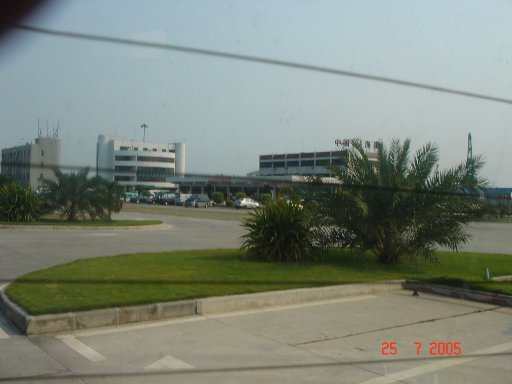
We arrived in Hong Kong and took a hydrofoil, something like a fast boat to Shenzen, my first time in China.
Photo: 1. Shenzen Port (entry point from Hong Kong) 2. Shenzen city skyline 3.Hang Sheng Electronics factory in Shenzen, 4. straight into the meeting room with them

Saturday, July 02, 2005

Enrique of Melaka : Was the first man to sail around the world a Malay

I read an interesting article reproduced here on the theory that a Malay and not Magellan was the first person toe sail around the world....who is this Enrique?

some answer from everything2.org
Enrique de Malacca, also known as Enrique Negro, Black Henry, or Panglima Awang, was possibly the first person to circumnavigate the earth.When he was a 13 year old boy, in Malacca on the Malaysian peninsula, he was captured and enslaved by Ferdinand Magellan, at some point around the year 1500. In 1519 Magellan's expedition set out to discover a route sailing west from Spain to the Moluccas, or Spice Islands. When the expedition reached the Visayan islands of the Philippines, Enrique was able to communicate with the islanders. Magellan was killed on the island of Mactan, betrayed by the Spanish officers in his service. Enrique then betrayed the officers to Humabon, Rajah of the neighboring island of Cebu, and jumped ship. The question is, did Enrique know the language of the islanders, or did they know Malay, a popular trade language? The impression from Pigafetta's journal is that Enrique was communicating fluently with the islanders of Cebu. If this is true, it's possible that he, not Juan Sebastian Del Cano, Antonio Pigafetta, and the other 16 survivors of the expedition, was the first to go all the way around the world. http://everything2.org/index.pl?node_id=1103828

Photo:Magellan, from acontemporary painting


Over the years, there has been considerable debate about who actually was the first man to sail around the world. We were all taught this historic honour belongs to Ferdinand Magellan (Fernao de Magalhaes, in his native Portuguese)who led the expedition of five ships and over 270 men out of Spain in 1519 and sailed westwards, reaching the Philippines, where he was killed. However, Magellan was thought to have travelled to as far as Sabah before, and one can argue that he had indeed actually completed circumnavigating the globe. Thereare also those who argue that the accolade should rightly belong to Sebastian del Cano, a mutineer from Magellan's crew, who led the one surviving ship, Victoria, and 17 other men, and limped back to Spain on September 8, 1522.

However, only one individual can truly claim to have been the first man to leave his home, sail around the globe and arrive at a part of the world where his mother tongue was spoken. That man was a Malay, Magellan's able servant and interpreter, called Enrique of Melaka or Henry the Black.

If there is any single Malay ever who has had the greatest impact on world history, it would probably be Enrique and we know so little of the man. He is called Panglima Awang in Malay literature but there is no mention of him in any credible Malay historical records. There is brief mention of Enrique in the official Spanish crew lists, as well as Magellan's last will and testament. Almost all of the certain facts that we know of Enrique come from the most comprehensive chronicle of Magellan's voyage, the narrative by Antonio Pigafetta, an Italian volunteer who joined Magellan's crew.

Pigafetta does briefly mention Enrique's origins - he was a Malay who had lived in Melaka but was originally from 'Zamatra' (Sumatra). Magellan was among the crew of the Portuguese squadron of five ships under Diego Lopez de Sequeira which sailed into Melaka on September 1, 1509, and became the first Europeans to have contact with the Malay Peninsula. Magellan also took part in the capture of the city by the Portuguese in 1511 and it was probably then that he acquired a Malay slave, whom he gave the name Enrique.

Photo:The Death of Magellan, from
a 19th century illustration

The young Enrique may have been about 18 at the time - Magellan's will and testament made eight years later cited Enrique as being "of the age of twenty-six years, more or less". The will also stated specifically that Enrique was a "captured slave" - indicating that Enrique was not bought in a slave market by Magellan. There were thousands of slaves in Melaka belonging to the merchants and Malay nobility, and Portuguese records indicate that Sultan Mahmud of Melaka alone had over three thousand 'hambarages' ('Hamba Raja' or royal slaves). Many were in fact prisoners of war brought back from Melaka's successful campaigns against the kingdoms of Sumatra, Enrique's birthplace.

Enrique must be a guide and interpreter when Magellan travelled to different parts of the East Indies after Melaka's capture, reaching as far as Sabah. He then sailed back to Lisbon in 1512, with his loyal Malay servant in tow, and was dispatched to the Portuguese campaigns against the Moors in Morocco. Magellan was later accused of corruption left the service of the King of Portugal and offered his services to King Charles I of Spain in 1517. Magellan presented the King of Spain with his plan - to find a route sailing westwards to the Spice Islands, avoiding the Portuguese. It is said that he even had Enrique presented to the King to convince that he a man with the local language, knowledge and experience will make the voyage a success.

Magellan later declare in his will and testament that, upon his death, Enrique “shall be free and manumitted, and quit, exempt, and relieved of every obligation and subjection, that he may act as he desires and thinks fit.” Magellan even left Enrique a comfortable share from his estate, “the sum of ten thousand maravedis in money for his support”

The Spanish king agreed and Magellan was provided with five sailing ships - San Antonio, Conception, Victoria, Santiago and his flagship Trinidad -
and crews comprising over 270 men. They left the Spanish port of Sanlucar de Barrameda on September 20th, 1519 and began the daring and historic voyage of exploration ever - a voyage equaled to Man's landing on the moon 450 years later.

Across the Atlantic, down South America and across the Pacific, they sailed and finally, on March 16th , 1521 they sighted Samar, the most easterly of the Philippine islands. But on March 28th, a momentous event occurred. Pigafetta wrote: “.... we saw approaching two long boats, which they called Ballanghai, full of men, and in the larger was their king seated below an awning made of mats. And when they came near the captain's ship, the said slave (Enrique) spoke to that king, who understood him well.”

As they continued their voyage to the surrounding island kingdoms, it was Enrique alone who, on behalf of Magellan and the Spanish crown, spoke with kings and traders. Magellan had befriended the ruler of Cebu, Raja Humabon and was asked to punish rebellious natives in Mactan, under a warrior named Lapu Lapu. On Saturday, the 27th of April, Magellan attacked LapuLapu's with 60 men-at-arms - cannon, muskets, crossbows and steel swords against bamboo spears and poison-tipped arrows. But the small Spaniard force suddenly found itself overwhelmed by over 1,500 of Lapu Lapu's warriors.

Pigafetta noted that Lapu Lapu's men were converging their attacks on the Spanish captain himself - Magellan was first struck in the right leg by an arrow and later a spear stabbed him in the arm. For some reason, his cannon had now stopped firing and, despite being pressed by attacks for nearly an hour, no reinforcements had arrived from his waiting ships. Wading knee-deep in the surf, he was finally pierced by a spear in the right leg and he collapsed face down dead.

Enrique himself was wounded in the battle. Pigafetta writes that “he no longer went ashore to do necessary business but was always wrapped in a blanket” A new commander replace Magellan - a Portuguese by the name of Duarte Barbosa. Shouting at Enrique, Barbosa told him that although his master was dead, he was not to be freed but was to remain a slave.

Pigafetta writes that Enrique went ashore and told Humabon that the Spaniards were about to depart immediately “but, if he would follow his advice, he would gain all their ships merchandise ... and so they plotted a conspiracy.”

The next day, Enrique told the Spaniards that Humabon had prepared jewels and presents asked them to come ashore to receive these. A party of Spaniards led by Barbosa did come, accompanied as usual by Enrique, but they were attacked. A lone survivor fled back towards the ships and, when asked if there were any others who survived the attack, he said all were dead, except the interpreter, Enrique.

Official Spanish records list Enrique of Melaka as one of the 27 men massacred in that attack, so we really do not know if Enrique did survive that attack, as Pigafetta claims. What we do know is that was the last we hear of Enrique in Pigafetta's diary - and he disappears into the mists of history. If Enrique had indeed made his way home from Cebu he would be the first man ever to have sailed around the world, rather than Magellan or del Cano.

One could also argue that the Spaniards may have indeed changed the official crew lists to ensure that this was not a possibility - how could a Malay slave have beaten the flower of Spanish manhood in the race around the globe? Certainly, Enrique was to be just a footnote to the heroic deeds of Magellan and del Cano that were told in countless books about this remarkable voyage written over the next few hundred years. Little was known about him even in Malaya until, in 1958, the writer Harun Aminurrashid published one of the greatest historical novels in modern Malay fiction, "Panglima Awang".

Despite Pigafetta's quite clear statement that he was from Sumatra, Filipino writers and historians are now claiming Enrique as one of their own countrymen. The most convenient feature of these theories is that if Enrique was indeed from Cebu, that would without any doubt make a Filipino the first man to have sailed around the world.

The main argument behind these theories is that Enrique could speak in the language of the people inhabiting the islands around Cebu - Bisayan - and therefore must have been from Cebu himself. There is a fatal flaw in this argument - Pigafetta's narrative above does show that Enrique could not communicate at all with the natives in his first encounter with them. It was only when he spoke with royalty - in this case, their king - or with traders that they suddenly found a common language among them. This is certainly not surprising - Malay was, by then, the 'lingua franca' of the whole Archipelago, and the official language of international diplomacy and trade for the whole region. All references to Enrique in Pigafetta's chronicle have him speaking with kings, chiefs or traders - rather than the common folk who may not have known the international language of Malay.

Enrique of Melaka had sailed the seas of the East Indies with his master; followed him across the Indian Ocean and around the rim of the African continent; loyally fought alongside him in North Africa; lived in the splendour of the royal courts of Portugal and Spain. He embarked upon the greatest adventure ever - to circle the globe, the final frontier; to explore strange new worlds; to seek out new life and new civilizations; to boldly go where no man has gone before.

Having done that, he had returned full circle, to a land where he could understand the people and they could understand him. And there is just still the possibility that this humble Malay slave was indeed the first human ever to have sailed around the world.


Pigafetta, Antonio, journal, quoted in Skelton, R.A., 'Magellan's Voyage--A narrative Account of the First Circumnavigation', New Haven: Yale University Press, 1969
Zweig, S. Magellan. 'Der Mann und seine Tat', Wien-Leipzig-Zürich, 1937 and Fischer Taschenbuch Verlag, 1983
Pintado, M J, 'Portuguese Documents On Melaka', National Archives of Malaysia, 1993.

for more details please follow this source: http://www.sabrizain.org http://www.sabrizain.org/malaya/port3.htm

GoogleAd

LinkWithin

Related Posts Plugin for WordPress, Blogger...